Monday, September 17, 2018

Keeping Up with Jimmy...In High School


My thoughts: I CANNOT believe that this is a post about Jimmy eh um...Jim going to high school! I still remember him as my preschool student. Where has the time gone? I've loved staying with him and his mom, Kristi as they take on new adventures together. I can't wait to see what lies ahead for the both of them.

Hello everyone! It has been a while since we have chatted. It is September 2018 and we all know what that means, the beginning of the school year for most. We have left behind Elementary School and Middle School/Junior High and now it is time for Jimmy to start his last school at home, ie. High school!!! With every transitional school year it doesn’t come without its challenges. This year we have had more than I have seen before with Jimmy. To start the first week of school were all half days due to extreme heat which also means he was not given a chance to get his bearings around school nor get used to his schedule, nor his teachers/administration had a chance to get to know him, so for all us parents of our blind students who are transitioning it means EVEN MORE HEADACHES.

As I sit here I don’t even know where to begin: classes, teachers, over protective administration who are comparing Jimmy to past students or the fact that Jimmy is in HIGH School. Let’s start with the fact Jimmy is 100% a teenage AND a high school student. And no matter what is said or asked of, or even reminding him to get his school work done we get an attitude for it. For the past 9 years I have been dreading this school year for no reason other than knowing that once THESE four years are over my only son is off to college and it is the beginning of his adult life. I truly am not going to dwell on the college years as I do have 4 more years to get through as most of us remember our high school experiences so we will have a lot more going on socially than ever before. Jimmy plans on wrestling for the school this coming winter which will be something new for him but hey he loves a good challenge.
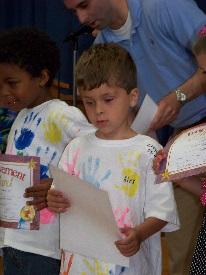
A picture of Jimmy as a preschooler

As we are only a week or so into school it has bee a ball of fun (insert sarcasm here) as Jimmy was NOT given a brailled schedule the first day of school nor have any teachers (that I am aware of) given him any brailled work, which means they haven’t given any to his braillist. He has already been given zeros on assignments because those assignments were uploaded to Google Classroom which he currently doesn’t have access to. (yes an email was sent out to address this after it was brought to my attention) One amazing thing though is that Jimmy has finally truly embraced his laptop and wants to do most of his work through this technology but with that being said we are already seeing difficulty accessing email, getting work sent to him, and then him back to the teachers but as with all transitions this will get worked out sooner than later. Due to all of the half days (we had a heat wave the first week and a half of school) the staffing meeting we had, had to be rescheduled, at which time we planned to go over all areas of concern the teachers MAY have as we are tackling a new school. The meeting was scheduled for more than a week later so thus we couldn’t get some of the challenges out of the way. This means the teachers had no idea how to get him his work or how he is going to his work back to them. This really puts a damper on not having any hurdles to get over because all we have at this point are hurdles.

As I haven’t had a chance to meet the teachers face to face only ONE teacher has reached out to me since the beginning of school to introduce themselves to me and give me a quick rundown on what is expected, if I have any concerns and that this teacher is excited to have jimmy in their classroom, the two even spent about an hour after school one day just talking getting to know one another. (Bonus points to this teacher). 

Jimmy was lucky enough to have a couple trips to school over the course of the summer to tour, walk, get to know his environment the best he could with no other students but even with this additional time he still found a way to walk into a display case. You may be asking if he was using appropriate cane skills to which the answer is yes, but the problem is/was that this particular display case is hanging on the wall with nothing below to allow his cane to indicate to him that there is something sticking a foot and half out from the wall until he found it with his face. He is fine and he went on about his day but the problem we faced was a friend saw it and reported it to the Principal. I know this was done out of concern for Jimmy to not get hurt but it caused the school to go on hyper drive over liability and claim that Jimmy needs to be observed. As I came to find out that there were a couple more safety concerns because I am allowing Jimmy to walk through the parking lot and walk home. At the school we have a couple of over protective staff members who claim that Jimmy was in danger of getting hit by a car (which was not the case AT ALL) but now Jimmy has to be shadowed for the next 2 weeks to make sure that he is safe. If Jimmy was not safe all the appropriate people, in particular his O&M teacher, would not have signed off on him walking.

Ok so let me back up a little bit, Jimmy’s TVI and I have been in lots of contact through this process and she did give me the heads up that the school was thinking about having Jimmy shadowed for a little while to just make sure he has his classes down and everything is good. His TVI told the administration to please contact Mom to discuss it with her prior to starting any shadowing of Jimmy. I bet you all can guess what didn’t happen, that’s right I did not get a call and again found out after the fact of this happening. Can anyone take a guess as to what happened next? That is right I marched right down to the school to have a face to face with Jimmy’s administrator. I am not going to allow my son’s independence be taken away that quickly with only 4 cumulative days at school.

As this is a new school the administration did not know me yet, but they do now!!! I have to say that the discussion I had with Jimmy’s administrator did go well, we both had a chance to speak about the who’s, when’s, why’s and now they are aware that if things happen behind my back and I find out about it, I am not going to just make a phone call they are going to see my face and we are going to talk right then and there. The one funny part to the conversation (at least to me) was when said administrator said that they want to be able to put my fear to rest which I then interrupted them and explained that this was not fear I had but straight anger for what was happening without my involvement. It was at this point I had to start educating them. When asked if I heard about him hitting his nose I said yes because my child talks to me about that. And the next question/statement was well he was asked to go to the nurse and he turned it down. I said yes I know, he turned it down because he was fine. I then pointedly asked the administrator if it was a sighted student who wasn’t paying attention and hit this thing and said they were fine, would everyone be up in arms? Their reply, no probably not, so for my child because he is blind we are not going to listen to his words of him being fine? Administrator saw my point and said you right we have to listen to what he is saying and not think he doesn’t know himself well enough to state weather he is ok or not. Furthermore they are already comparing him to another. 
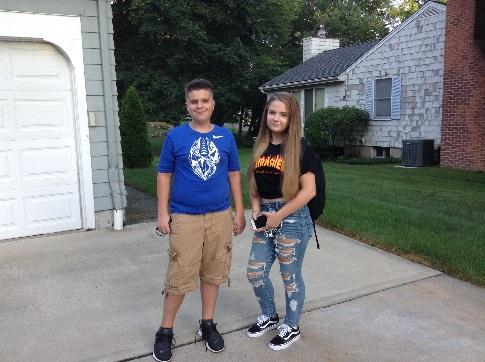
A picture of Jimmy on his first day of high school with a female friend.

You see another blind student just graduated at the end of last year, so the school has had a blind student so recently that one would have assumed they would give this NEW blind student a chance to get acclimated to the school. And from what Jimmy was telling me they (the staff) are already comparing my child to this child. I feel as a parent of a blind child it is part of my job to educate the sighted world as to the fact that no two blind children are the same just like no other two people (no matter the circumstances) are alike. It has been my experience that as soon as the word blind, or deaf, or disabled are used people have a preconceived notion that two individuals with the same dis-abil(able)-ity (see what I did there, the word able is in the word disability and they have to recognize that are children are still able to do things) are the exact same, but in actuality that does not mean that those two children have the same skills, personalities, or even the same acceptance to where the cards they have been dealt. My child and this other child are complete polar opposites that any two kids can be. And it is really frustrating to have to explain, yet again, that the staff has to look past the blindness of these two students and look at the student. When all of this was discussed with the administrator they said well I already see the differences between the two and Jimmy’s teachers will as well. I was like that is all good and fine but what about the rest of the staff who does NOT have interaction with my child but instead just assumes he is like the other boy. Everyone has to be told to have an open mind in regards to the different children.

As Jimmy is now in high school he has to continue to speak up for himself which he does very well. This time he asked me to start the conversation as he sincerely didn’t know who to go talk to. The administrator I spoke with did pull Jimmy aside the following day to have a conversation about all the goings on and they were able to have an open and honest conversation about it all. Jimmy got to convey his perspective on how things are going and to speak towards the “incidences” and the administrator also took what Jimmy had to say to heart. Jimmy is and will be fully involved in his education and things he like and doesn’t like. If he feels there is something that can be changed and will be hands on.

I know it can at times seem that the schools, administrators, or even the teachers don’t get our kids but that is why I will always be outspoken with them and try to get them to be open and understanding that our kids are just that kids who have the right to be independent and left alone to enjoy school like all the sighted kids. Are they “different” I guess you can say that but that doesn’t mean that they are less-than anyone else if nothing else they are more-than because they have had to face a harder life and continuously have to Prove themselves to everyone around them that they ARE just like everyone else. They are students who are just trying to navigate growing up like everyone else and if that means I have to be momma bear at times to get people who don’t know my child well to understand to back off and let him be, than by George that is exactly what I am going to do.

It is hard to be a parent of a blind student, especially when you enter a new school and have teach them all what said child is capable of. This does not happen with sighted students only with students who have an IEP, 504, whatever the case. We (or at least I) want to just scream in their face to back the #&( up and let my kid be. He can handle himself and if he can’t he will be the first one to ask for help or guidance. I want to scream to give him more than 3 days to get used to his school and show you who and what he is. I want to scream he is a typical 9th grader who doesn’t want to be treated any different than any other child in the school. Please give him room to grow and be comfortable in his own skin, do have a preconceived idea of who or what he is. Take a minute and talk to him (this part goes for the other students too who just see someone different and assume they know what he is like) isn’t that why you went into teaching to help and teach our children to be the best version of themselves and give them a chance to become productive humans in this world we live in? STOP ASSUMING and take a minute to learn.

Come Tuesday we will be starting our second week at our new school where we have both Open House and the Staffing meeting. My hopes are I meet everyone at the Open House and then the staffing meeting will be a breeze and I will not be fighting will all the teachers on who’s, what’s, where’s, and how’s. Hopefully they will be open and willing to do things just a little different to make sure that Jim is included in all areas of the classroom because if not we will be seeing each other real soon and after that meeting Jimmy will be included through modifications that I will do my best to give them if not I have a wonderful support group (TVI’s, past ECC instructors, and other families) to go to help give me ideas on how to best help the class and Jimmy. So for now so long and keep your fingers crossed that everything will be worked out within the next week and I will never have to think about it again. (I know it’s kind of a pipe dream, but a mom can hope for this Right!?)

Monday, August 20, 2018

Teach STEM & The ECC Using Kibo Robots


Blog graphic that says "Teach STEM & The Expanded Core Curriculum Using Kibo Robots with a pciture of a Kibo robot.
 Happy back to school everyone! I apologize for the big delay but I have been a very busy bee these past few months. I am just settling back in for regular blog posts. I have so much to share! I am always on the lookout for opportunities for our students and I stumbled upon the Kibo robots at STEM Fest last year. I immediately jumped at it because the accessibility would be so easy. Kibo robots are originally designed for early childhood but I find that I can use them for older students, too. I like how I can create simple concept development to pave a good foundation for robotics, engineering and programming. Plus, you can add the A and make it STEAM! They have lots of fun addition parts to be creative. I have used them several times with students and most recently at our Survivor on STEM Camp Island residential camp.
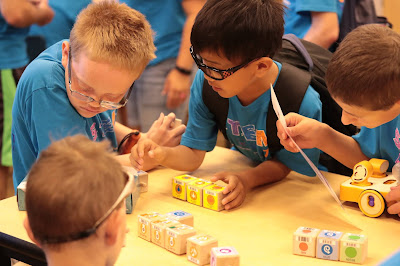
  Elementary age male students writing a program using the Kibo program blocks.
Elementary age male students writing a program using the Kibo program blocks. 
It's not just STEM that we can teach with the Kibo robots. It's about connecting it to the real world and that's where the ECC comes in. I infuse a lot of ECC concepts as I do my pre-teach with the robots such as asking the students how robots work in the real world or creating concept development about what robotics really is. Check out a video about the Kibo robots:
 
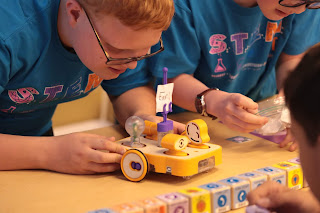
A Kibo robot with all four sensors: light, eye, telescope and listening
I have taught with the Kibo robots for students of all ages and visual abilities. My students who are totally blind can use them as can my low vision students. It didn't take much for accessibility either. We did make Braille labels for the programming blocks. The classroom kit comes with a game called Kibo Says. The game has "large print" cards which is what I use with the students who cannot easily see the blocks. You can still scan on them and they totally work. Plus they come with the kit--no enlargement necessary. I also pull out our handy Visolux (see picture below) just for quick magnification and to incorporate use of assistive technology (an ECC area!).
  A Visolux magnifier magnifies the program blocks on the screen.
A Visolux magnifier magnifies the program blocks on the screen. 
The Kibo robots lend themselves well to building concept development--meaning that there isn't a lot of abstract to make tangible. I start my lessons with new students by going piece by piece of the robot and they will build it together so they know each piece. We discuss the wheels and how to lock them in and discuss the function of each sensor. I also specifically discuss how the scanner works (and then discuss where else these scanners exist---a grocery store is a great example as well as a connection to the real world ECC).
A student hand is reaching to work on a Kibo robot.
A student hand is reaching to work on a Kibo robot. 
There are lots of games such as bowling. My students have loved just creating with it. Here is a list of examples of activities: http://resources.kinderlabrobotics.com/activities/. You have to begin each program with a start and an end which is really nice. It is easy to have defined and tangible concepts for students that have no vision. All of the students that I have introduced them to (from grades 3-12) have really liked them.

                                         Kibo Says cards in full size (8.5x11)
                                   Kibo Says cards in full size (8.5x11)


Male middle school student works on a Kibo robot. He is scanning the program blocks to the robot.
Male middle school student works on a Kibo robot. He is scanning the program blocks to the robot. 
You can infuse so much Expanded Core into your Kibo lesson! Think about spatial awareness and directionality (orientation and mobility skills), working with a team (social interaction skills), problem solving, self awareness and making choices (self-determination), all the jobs in the STEM field, following simple and complex directions, cleaning up the Kibo, etc (career education). Those are just a few examples of skills and concepts you can specifically target in your Kibo session. The only accessible thing we did was add Braille labels to the program blocks. Everything else was pretty much accessible. The direction cards did need Braille and LP copies but that wasn't hard at all to do! I've had a great experience working with the company since I purchased these for our school. Give them a call and tell them you heard about it from me!

Thursday, June 28, 2018

Teach the ECC at a Cowboy Dude Ranch!

 Yeehaw!! Howdy partners, let's teach the Expanded Core Curriculum out on the range!  We spent four days at the Rocking R Dude Ranch and got country strong on our ECC skills. Many programs look to do a variety of programs for our students. Going to a dude ranch was a first (but definitely not a last) for me! First, let me tell you that this was not designed to be any kind of luxury country getaway for students. I wanted students to dig in their boots to cowboy life with the ECC. It was a hit! Each day we did real chores (emphasis on the word "real"), spent time developing true global concept development and we had some serious fun! Students had to brush and prepare their horses, lead them to the arena and then learn how to ride. They got up early to watch and be part of the early morning care with the horses (watching them with the wranglers was awesome!!).

Student brushes a horse in the early morning.
Student brushes a horse in the early morning. 
As usual, I did receive a slightly panicked phone call from the owner when he saw that I was bringing a large group of students with vision impairments (everyone is always a little concerned...) but after our discussion, we knew that this was a good idea! Once we got there, I definitely knew it was a good idea!! I spent time reviewing activities and working accessibility needs prior to us arriving. My awesome staff spent the first day on pre-teaching alongside of the ranch staff. 
Female student sits on her horse listening to instruction from a dude ranch staff.
Female student sits on her horse listening to instruction from a dude ranch staff. 
Always remember to request (or bring) multiples of items so everyone gets lots of hands on to help with concept development. We had a ton of lassos, access to all the saddles, brushes, etc. so that true concept development could happen. Students didn't just touch one part of the animal. They learned about the food, its shelter, its weight, leisure activities, etc. Each group traded trivia questions that they came up with. 

Female student has roped a practice bull with her lasso while another student gets up close to a lasso with a staff member.
Female student has roped a practice bull with her lasso while another student gets up close to a lasso with a staff member. 
My FAVORITE thing to do is to help students see how the ECC is EVERYWHERE in their lives! Repeatedly throughout the day I worked with every group about how and why their activities were ECC skills. We have definitely gone past the easy point of simply stating "this is independent living skills because I am eating," (that's just our starting point...). We really dig in to why the cafeteria is a place for ILS skills, what about what they are doing, we dig into every single aspect so that they can see how it is SOOOO much more than independent living skills because we are eating. In fact, we always discover how so many areas of the ECC can be tied to one activity. It always opens their eyes to seeing how the ECC is truly all day, everyday. 
Students are in a circle for lawn games playing a game.
Students are in a circle for lawn games playing a game. 
Female student walks her horse into the arena while an adult staff leads on the other side.
I loved being at the dude ranch because it allowed all of my students to connect to the world in ways many of them don't get to experience. They had to problem solve while riding their horses. They had to work their teamwork skills as they were tubing down the river. They saw how important it is to care for an animal in real time. Of course many students have had animal interactions before. But this  opportunity allowed them to go bigger and bolder. They had plenty of time as no one was rushed through anything. We even had a real rodeo where all the students (and a very slow riding teacher named Robbin) did barrel racing and pole bending. 
Female student is hands on with goats with an adult staff member
I always love doing programs in the community for a variety of reasons. One, it helps the community see ability instead of disability with our students. They learn so much about accessibility and ability of people with vision impairments. I always offer to do free trainings, leave tactile maps, etc. so I leave the facility more accessible for the next blind person.  Two, the more I do things in the community, the more my students learn about what's available in the community. Three, I hope that it creates the opportunity for my students to return to the location with their family and friends outside of a program/camp. 

a female student is on a barrel to simulate riding a bull while other students pull attached cords at the corners of the barrel for the simulation
I could go on and on about our daily activities and how fun (and so educational) they were. Our evening activities matched the day with ECC fun! We had campfires (who doesn't love a good fire and camp songs?!) as well as learning how to line dance with a live country band! I secretly love line dancing because it is such a fun way to teach so many orientation and mobility skills! 
A group of female and male teenagers stand together with their life jackets on before going tubing in the river.
A group of female and male teenagers stand together with their life jackets on before going tubing in the river. 
The magic of camp can continue as long as we work hard to connect skills from camp to the real world at home. This is the part that often is a negative for camps and programs for our students: it's not in the student's real world. How do they keep their skills going? Where are they going to get a horse again? Well, the horse I can't help with but the skills part I can. Even though we were at a dude ranch, I kept focusing on the take away lessons and skills. We do this every camp and program. How can you take home what you are learning at camp? How can I empower parents to help keep the magic going? We have to close the loop and help students learn to generalize their skills to other environments. First I focus on the immediate environment but then I start leading to master in many environments. It's an important part of all our programs!
Get your cowboy boots on, grab your hat and head to a dude ranch for down on the range ECC instruction!!

Monday, May 28, 2018

Study Abroad ECC Australia

A study abroad program based on the Expanded Core Curriculum
I am so excited to share this post with everyone because this is all about Study Abroad ECC Australia! This has easily been added to my top 5 education experiences. I almost don't even know where to start. Just kidding! I will start at the beginning. The beginning is gratitude to my school, the Utah Schools for the Deaf and the Blind, for supporting this idea! Two years ago I led us on an exchange program with Camp Abilities Ireland and that kicked off our study abroad program. I learned that Australia also has a recognized Expanded Core Curriculum and started researching schools. And now we had a study abroad location: Australia! 
We partnered with RIDBC Sydney and SA School for the Blind (SASVI) in Adelaide. 
It was critical to us that our program was a true education endeavor from start to finish. Students had to apply for the program based on a college application. After a review committee used a rubric, scored the essays and selected the students, we were in business!

students with vision impairments pose for a group picture with art
We spent the next 2.5 months together in an Expanded Core Curriculum bootcamp! The entire study abroad program was based on the ECC--my dream scenario :) Each week students completed projects from transportation to recreation and leisure. We used distance education, technology and on campus sessions for our work. One of my favorite instruction tools was using some of my former students as mentors. These former students are all domestic and international travelers. We had Zoom sessions (like Skype) and students asked questions and listened intently to advice from mentors. 
 Here are some of our examples of lessons that we did in preparation for traveling to Australia:

  • On campus session. Students had to work with their mobility instructors and themselves to coordinate traveling to campus as a group. No parents could provide transportation to campus.
  • Financial Academy. They also had to be enrolled in our distance education financial academy. Coursework went beyond budgeting but also covered accessibility for banks, where they want to live and the real world budgeting. 
  • Fundraising and coordinating. Students organized a variety show to help support their financial needs. They were in charge of coordinating, entertainment and ticket sales. 
  • Transition. We spent a lot of time focusing on skills (for right now) that would be needed later in adulthood. We used the Transition Skills Competency Checklist.
  • Weekly ECC in the real world projects. The main goal of the program was to help students see how the ECC is every where in their daily life. They learned all the skills that comprise the ECC. It was more in depth than just saying "independent living skills". They could list skill after skill that were included in the ILS section. 
  • Communication & presentation. They developed their public speaking skills for sure! The students were responsible for all presentations. They gave ECC presentations at schools, with Aussie students and teachers. They will forever remember all the areas of the ECC!

teacher holding a koala

There are few experiences these days that teachers can really feel like they are doing it right. This was my experience. We often write IEP goals, do lessons, camps, etc. but it's tough to see it all through. For the entire program I was able to "see it all through". It was fantastic to teach, coach, model and then watch them not only implement it but to get it in the marrow of their bones. These super six students learned to see how the ECC is part of everything they do and how it is the most important part of their education.
t shirt that reads: And then I learned that adventure was the best way to learn

Sydney Opera House
 What else besides the Expanded Core Curriculum did we do? The ECC was the most important objective of our instruction. However, in order to show how important it is, it needs to be taught through meaningful experiences.

Here are some of our adventures:

  • Touch tour of the Sydney Opera House. We had a special tour with a lots of hands on! The tour guide even brought out a small replica of the opera house. We got to get hands on and go back stage and see the sets, one of my students had the opportunity to sing and we got to learn so much about the famous opera house. 
  • Sydney Harbor Bridge Climb. This was an unforgettable experience! We suited up and climbed the iconic Sydney Harbor Bridge. Many of our students had very limited vision but we were still able to do so much on the bridge climb. We divided into small groups and got hands on and ears on with the climb. 
  • Sports, recreation & leisure. We had a variety of different recreation activities that were a blast! Most notably, we learned how to play a variety of sports that were accessible for people with vision impairments. We loved learning how to play blind cricket and Australian Rules Football. 
  • Australian Rules Football match. This one needed its own line because this was another unforgettable experience! We got to get on the field and high five the players as they came out. We had never seen this before so we loved learning the game. Thanks to our friends at SASVI who taught us how to play. 
  • Our koala cuddle. We loved visiting the Australian wildlife parks and learning about all the different native Australian animals but our favorite was the opportunity to hold a koala!

student playing blind cricket

group of students with vision impairments at an Australian rules football game

one male and one female student holding an Australian rules football game ball
The students had lessons on everything in the ECC (are you sick of me saying that?) especially in transportation situations that they don't always encounter. We did the traditional bus lessons but we also did lessons for taking a ferry, taxi/Uber, train and finding our way all over Sydney! That was no small feat as there is a ton of construction in Sydney.

The best part is that this isn't our only program. We are so excited to continue our Study Abroad programs! It truly has become one of my most treasured teaching experiences.
Add caption

Thursday, April 26, 2018

Use the Expanded Core to Teach Financial Literacy


Teach Financial Literacy Skills and Expanded Core Curriculum

A major part of independent living skills in the Expanded Core is money management. Money management skills are part of financial literacy. All youth need solid financial literacy skills for adulthood. We all know what happens when you don’t have good money skills! 

Many of our students receive ECC money management skills in terms of money identification skills. For example, folding money and using apps to identify it. However, there is so much more that our students need! Let’s incorporate the other ECC skills areas to help build a solid financial literacy skills foundation!

I recently started a distance education program with our school. The students do a majority of their learning at home and attend sessions over distance ed technology with me. They also come to campus for two full days of intensive hands on learning. 

I didn’t want to recreate the wheel with writing a financial literacy program for students. That can be super time consuming! I researched several programs and came away with a winner: Orange Owl Academy! There are several solid financial literacy programs but Orange Owl covered areas that many programs lacked. Orange Owl covered growth mindset, comparison of costs and had the most opportunities to implement ECC skills (beyond money management). 

Here’s an example of how I infused ECC: There is a section in the program where Teacher Taylor from Orange Owl asks students to think about their future home. I was able to implement transition skills, career ed and orientation and mobility into this whole session because we discussed transportation considerations, roommate living and access to work. 
Orange Owl has all videos that are accessible and a workbook. The workbook was a bit of a challenge for converting to .brf files (there were a lot of tables) but thanks to my faithful colleague, Becky who converted everything. We had a fully accessible workbook. 

We spent two full days on campus and that is where we targeted blindness specific skills. I also brought in some young adult blind mentors who helped lend some experience, tips and tricks for my students. 

The price for Orange Owl is $69.97. Our school paid for the subscription. The bonus is that our students and their family could do this together. We invited parents and siblings to do the course. The distance ed piece were weekly Zoom (like Skype) meetings. We did Orange Owl + the Expanded Core for 8 weeks. Each weeks has a theme that works with the Orange Owl curriculum. The Expanded Core piece is based on the EVALS assessment and the skills from the ECC. 

As the teacher, using the Orange Owl Academy curriculum helped me to focus on the ECC. I didn’t need to recreate the wheel with what financial skills to teach. It was a great partnering for me as I had students from all over the state participate in the program. 

Are you ready for the best news? 
I have spoken with Teacher Taylor from Orange Owl and we would love to invite more students to join! Families or schools will buy the subscription and can do the Expanded Core work with me. Please contact me, robbin.keating@gmail.com for more details. The Financial Academy can be done year round. I had some students who were able to get school credit for this. 

Here is the link for Orange Owl Academy to check out the program: https://www.orangeowlacademy.com


Monday, February 19, 2018

Make Your Own ECC Skills/Assessment Binder


Hi friends, A few weeks ago I decided to organize all my ECC assessments because I am always referencing them when writing lesson plans and activities. For every single thing I do with my students, I always reference my ECC assessments, EVALS and ILSA. I have previously scanned all my ECC tools into Google Drive and made them editable pdf files so I can use them easily. But accessing the digital files was tough when I am laying out all my resources. The answer came when I decided to compile all my ECC tools--skills, screening tools, assessments, examples of each area, etc.  into an easy to use binder. I've LOVED it! I use it all the time and all my tools are at my finger tips.

I whipped up a fun cover for my binder with an at-a-glance list of everything in my binder and hole punched all my copies. It took me about 20 minutes to make it all happen.
Here's what I have in my ECC Resource binder:
First is my areas and skills of the ECC handout that we made for our teachers. This is an at-a-glance of each of the 9 areas of the Expanded Core. This way I can always look for how each of the ECC areas can come up in school routines or activities.
5 of the 9 areas of the ECC with a bulleted list of skills for each area.
Picture of the areas & skills of the ECC handout.   
I also keep several sections of EVALS in my binder.  EVALS is a comprehensive assessment for students with vision impairments developed by TSBVI. I love EVALS because it is specifically written for students with vision impairments. Too often I meet teachers that borrow from other disability groups and use their assessments. The problem with borrowing those assessments is that it doesn't cover the unique needs of students with vision impairments. Our students require a special sequence of skills. I use the Exit  Assessment (both for students that need on-going support and will not need the support). EVALS comes as a kit with other tools in it: 
  • Two books of evaluations for the ECC areas
  • One book of evaluations for academic subject areas for Practical Academics and Basic Skills students
  • Independent Living Skills Assessment and On-going Evaluation
  • TAPS Comprehensive Assessment and On-going Evaluation
Every TVI must have access to EVALS! I can't say it enough--I use it for all my planning! If you are unfamiliar with EVALS, you can read up on it (and purchase it) here: http://www.tsbvi.edu/curriculum-a-publications/3/1030-evals-evaluating-visually-impaired-students

I also keep a copy of the entire Independent Living Skills Assessment (ILSA) because I also consider it a helpful tool. I use ILSA a lot to see the sequence of skills in each section. I also like it because it has the age group target so I can look forward and backward for each group of skills. The ILSA is a little out of date with skills (like they reference using a phone book) but it still has a lot of valuable use to it. I like to share the ILSA with parents because it shows them what skills by what age are ideal for students. I often copy a few pages and send it home and ask parents to fill it out to see what kind of skills students can do at home. 
I also keep a copy of my ECC worksheet that I use with my teachers. I use this worksheet when reviewing ECC skills instruction during everyday school routines. I use this worksheet when I am planning lessons and activities. I always outline how the activity meets the areas of the Expanded Core in my lesson plans. 

Other items that I have that are not pictured are an ECC screening tool developed by Karen Blankenship. You can get the screening tool from the website EA Rubrics. Here is the link for it: http://earubric-001-site1.mysitepanel.net/ecc-needs-assessment/. EA Rubrics has a lot of valuable information for teaching the essential assessments for students with vision impairments. The essential assessments are a functional vision assessment (FVA), learning media assessment (LMA) and the ECC screening tool. 
I totally recommend that all vision professionals create an Expanded Core assessment/skills binder. It makes referencing skills and evaluating skills easy. Plus it helps me really know the areas and the skills. I have memorized several areas because I reference them often.