Showing posts with label APE. Show all posts

Friday, December 29, 2017

Teach the Expanded Core at a Ninja Gym!

Teaching the Expanded Core Curriculum at Ninja Warrior Gym
Hi friends, you know I like to make the Expanded Core Curriculum as relevant and meaningful as possible for our kiddos so check out this community based instruction (CBI) lesson at a ninja gym! First, it is important to note that I didn't just show up at the ninja gym and to just play and hang out. The ninja gym was part of my short term program, Ninja Jam (a ninja twist on my annual December Jingle Jam). It was such an awesome way of teaching ECC skills! 
Before we headed to the ninja gym, we spent the morning discussing life obstacles. All of the students were divided up according to age. I write lesson plans for my staff so they can lead discussions with important talking points. I also made sure we touched on growth mindset as part of learning how to crush life obstacles. I love growth mindset for my students and my own kids. There is so much we can use from growth mindset as part of ECC instruction. 
Each student completed a worksheet (see picture below). Note: I made sure the font was a size that all my low vision students could see (some had theirs on 11x17 papers and we used 20/20 pens). We made Braille worksheets for our Braille readers (using simple peel & stick Braille labels and old school Perkins Braille writer). 

Here's a snapshot of my lesson plan discussion for my staff:
Can you see how we are working Expanded Core skills for this activity? We are hitting all the areas in this small group activity. 
Next we headed to the Ninja Warehouse in Ogden for an awesome ninja session! This took some planning and pre-teaching on my part. I went to the gym a few times before and thought about how I could take obstacles that were up in the air and make it meaningful. Thanks to the ninja coaches who gave me lots of help! My best tool for teaching about things up in the air: a white cane!

 We divided students into small groups and different stations. Students with no vision had a guide and we did tactile modeling of body positions.
The black & red colors were a bit tricky for some students because there was so much black & red but we managed well. Below is a picture of one of my students who has some vision (but is Braille reader) using her cane to see how high up the Devil Steps obstacle went.
 Then my daughter who was this student's guide runner in a lot of things we have done over the past year went side by side to show where to grab. Another note: I like to use peers whenever possible with typically developing students. I think there is too much of a stereotype that our kids always need an adult with them. I use peers as much as possible.

 We used A LOT of tactile modeling for body positions. We were very lucky to have Karson Voiles (owner of the ninja gym and an accomplished American Ninja Warrior come in and coach us.) He held a lot of positions over and over so students could feel how to position their body (major kudos to Karson because he had to do it a lot!).
 The ECC instruction covered everything from what clothes and shoes you should wear (independent living skills) to concept development (compensatory skills). It was a full ECC day of learning!

We had students with low vision, no vision and deafblindness attend our Ninja Jam. Check out my Instagram (9 More Than Core) to see video and more pictures of my students crushing obstacles. 
I'm not gonna lie. Some obstacles were a challenge for students with no vision such as the Warped Wall. Luckily there were kid sized walls that helped with the concept development. We had students feel the wall (to get the idea of the curvature) and the ledge. Then we did practice runs where I ran along side my students with our hands touching. I yelled "grab it" when we got up to the ledge. It only took these awesome students one practice run and they were climbing the wall like a champ! All of them pulled themselves up and onto the top. I did something similar on the larger version. It just goes to show you that it really isn't about what they see, it's about what they do!

Sample of Expanded Core Skills Covered:
Compensatory: concept development, reading & writing, spatial concepts, speaking & listening, organization
Orientation & Mobility: travel, body awareness, spatial concepts, locomotor skills, requesting/declining assistance
Social Interaction Skills: interpersonal communication with others and instructors; learning socially relevant conversation (why are so many people interested in American Ninja Warrior or parkour training)
Independent Living Skills: discussion of appropriate clothing and shoes for the gym, time management, organization
Recreation & Leisure: learning about obstacles, skills and activities (we had one very low vision student a student at the gym already!). 
Career Education: what jobs are available in this type of area; how to become a coach (and discussion about what make a good coach), following rules, waiting in line
Assistive Technology: We actually had an APPetizer party as part of Ninja Jam where we learned about different apps and how they can help in real life. Students took pictures of obstacles on their phones and magnified them so we could look at details that were far away.
Sensory Efficiency: We definitely had to rely on all remaining senses and vision to be engaged in the activities at the ninja gym.
Self-Determination: There were so many SD opportunities! Students made choices about what they wanted to do, developed preferences, learned about skills and talents for different skills and obstacles, requested assistance or identified where they needed it, made a plan of action (life obstacles). 

Tuesday, April 28, 2015

Hungry, Hungry Hippos!

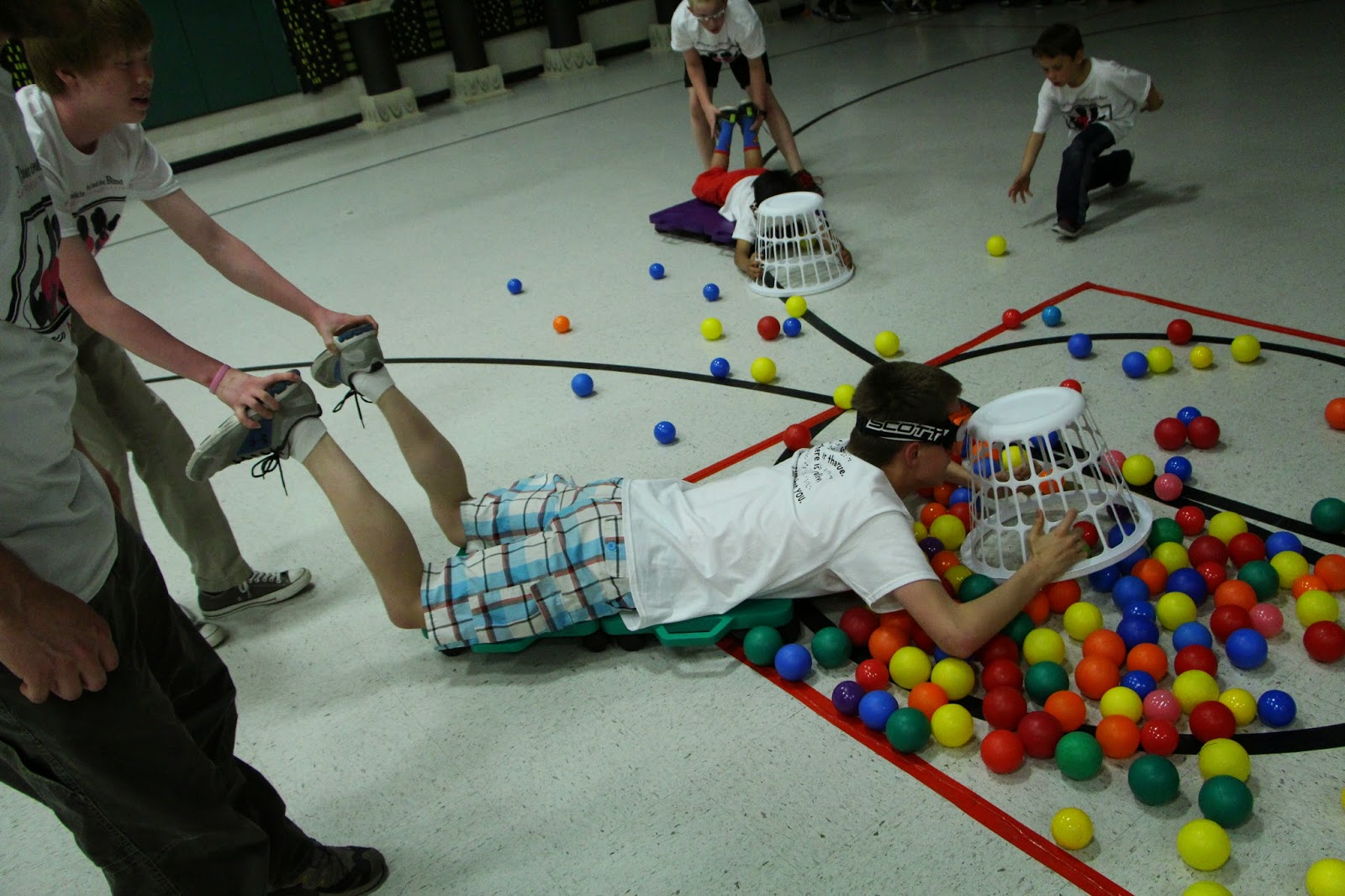
Have you seen the human version of hungry, hungry hippos on Facebook??? I saw it and the moment I saw it, I knew I had to do this with my students!! I shared the link on FB with my APE/PE peeps to get their ideas. I spent some time carefully thinking about modifications and meaning. I wanted this to be awesome and fun, yet hands-on and meaningful for my students with little to no vision. We decided to debut it at our most recent program, Girls Weekend/Man Camp as our finale battle of the sexes game. Holy Hannah, we had the BEST TIME EVER!!

Here's how we did it:
1. I bought some regular play balls (that you would use in ball pit). I bought mine from S&S Worldwide. You can buy them anywhere. They are pretty standard. I bought the pack of 100 and realized that with over 20 people playing, I would need more. I would plan on two. 
2. We established the playing area using floor tape. My new fave PE teacher, Nick, made the "game box" similar to a goalball line (we put rope underneath the floor tape to make a tactual boundary). Brilliant idea!
3. We wanted to establish an audible cue to let students know that they were approaching the "game box". We used our trusty beep kickballs for this and had an extra APH sound source on hand. If players captured a beep kickball, it was worth a bonus 25 points. We played two rounds with the beep kickballs and then retired them. We used the beep kickballs as 'training wheels' to teach students about what and where the balls were. 
4. You need to do pre-teach skills with "trapping" (using the baskets to get the balls). Make sure students understand that you can only do one "trap" with the basket. Students quickly figured out effective strategies for getting maximum balls (one popular strategy was when they 'trapped' the ball, they kept their forearms close to the ground so that their arms also 'trapped' balls. 
5. I saw a few versions of the game where they used rope to reel the player back in. I decided to not go this route because I wanted to go for maximum participation from everyone on the team. We had 'drivers' that drove students out and then brought them back. This allowed all students to understand all the facets of the game, especially our students with little to no vision. 


 6. Students laid down on two scooter boards that were hooked together. All students who were playing the role of the "hippos" wore goalball goggles. I wasn't sure if everyone knew what goalball goggles looked like so I included a picture. My phone erased my original picture so I borrowed a pic of the goggles online. See below. 

7. We played until all the balls were captured and the each team counted up their total balls. Each time a team sent a "hippo" out to trap balls, they had to change players (both drivers and hippos). This allowed the everyone on the team to get maximum participation. 


Equipment Recap:
1. Play balls (for a ball pit)
2. Beep kickball and APH Sound source (if needed)
3. Two scooter boards hooked together per team
4. Floor tape (we made our "game box" with tactual lines--rope with floor tape over rope).
5. Medium size laundry baskets. We bought ours from Walmart for a couple of bucks each.
6. Goalball goggles for each 'hippo'

At first we were concerned about collisions but we got pretty lucky with almost none. We had plenty of referees on watch that helped coach and ensured that each team did just one 'trap' per person. We had a variety of ages and visual abilities (including students who were deafblind) play. It was SO fun! It has definitely been added to our fave games list. I can't wait to play again!!

*Just in case you were wondering, the girls won the game!!

Sunday, August 24, 2014

Color Happy at Camp Abilities CT!

I have done a lot of super fun things with my students but this past August at Camp Abilities 2014 was hands down one of the best things I have done at camp. It started with the custom Carolina blue sunglasses that read Camp Abilities CT on the side. Next was the 75lbs of colored corn starch that I ordered. Then it was matter of planning with my team--what would be our route? All of this was in preparation for the first ever Color Happy Camp Abilities CT run!!
Holy cow, this was a BLAST!!! We lined up our guide runners for our cane users. We manned our color bomb stations. My student interns proudly took the last color bomb station. All of camp put on their white shirts and our run was on!
The colors were bright and fun to see for our low vision students. Our Braille readers got to touch, throw and bomb each other and got into the fun, too. Everyone at Camp Abilities CT was getting color happy :)

My interns and me. What a great time!

 All of our kids wore protective sunglasses. We did want to make sure that protective measures were taken. We did monitor to ensure eye safety. Our students that wear glasses wore these over their glasses. And you have to admit, the glasses are just plain out cool! How fun were these for our students to take back after camp to wear with their friends?!

 Here's Gissell (from last post) and me (with baby Abigail) at the run. 
I am SO proud of this girl!
Our fearless Camp Abilities CT  leadership team--what would I ever do without these guys?


 Why a Color Happy Run at a camp for children with vision impairments? Because it's a RAD thing to do! This was a great opportunity for our kids to get involved with something popular that their friends and family are doing. Running is a terrific lifelong activity for our kids to be involved with. 


 We also gave each person their own color bomb packet for our big party at the end of the race. We had a gauntlet that everyone ran through as we finished the race. 
This was just a total blast! I can't wait to do it again!!
You can do this, too! We ordered the color cornstarch from Hippie Powder and the glasses were custom made from 4Imprints. We planned a clear trail and assigned guide runners and supervisors throughout the course. All of our color bomb stations colored our kids as they ran past. Then we just had fun and bombed each other at the end. Let me know if you do one. I would love to see pics!

Thursday, March 13, 2014

Beep Kickball Tutorial

Hi friends,
Here is the last of the recreation game tutorials that we have made this year. Last but not least is beep kickball. I've blogged before about beep kickball. We started playing it awhile back at camp as our opposite rotation to beep baseball. However, beep kickball quickly gained popularity and we play it all the time now without needing an opposite rotation. We have so much fun with it! It's a great game that can be easily and quickly taught. See my other posts on the official rules and game play. Here is our latest and greatest tutorial starring another of my fave PE teachers, Craig Boucher. 


Sunday, March 2, 2014

Modified Team Handball Tutorial

I am SO excited to share this tutorial!! This is the modified team handball tutorial and this game is SO MUCH FUN! We have successfully played modified team handball several times with students as young as 2nd grade and with a range of vision impairments. We have had some dynamite totally blind youth and adults play this game with so much success. 
Our trial game of modified team handball 2012 at Girls Weekend

A few of the key points to remember: 
  • Use the numbered pinnies!! You need the numbers to help with the passing sequence and for the man-to-man defense. 
  • Practice the passing drills before playing a live game.
  • Use good communication between players ("Passing", "Got it!")
  • Have guides on the field (in the game) and as referees.
We play modified team handball with a beep kickball. We love this ball! It's light weight, good sound and has so many uses for different sports (including beep kickball---keep an eye out for that tutorial next!) Here's where you can buy your beep kickball: http://www.beepkickball.com. Judy, over at the National Beep Kickball Association, is a stellar lady who gives great customer service. 

We have played this game enough times to work out the bugs and modifications. Lots of our students have given great feedback to make this game fun and run smoothly.

This is the brainchild of Lauren Andersen and me with the vision modifications. Lauren does a great job of teaching on the tutorial. 


I would love to hear feedback about playing. Feel free to email me questions or feedback after you play. Our tutorial shows three players per team but we usually play with about 5 (max) per team. 

Wednesday, December 18, 2013

Group Games Fun

Let me share one of my new favorite resources! Sometimes it can be a bit tricky to find group games, ice breakers, etc. for kids with vision impairments. This summer I found some super fun ideas for Minute to Win It games but it was slim pickings as not every game was vision friendly. I was perusing the web looking for leadership games and activities with some fun group games and got lucky!

First, here's the website:   http://dragon.sleepdeprived.ca/games/games.htm.

Don't get overwhelmed by the amount of categories and games! I spent some time going through the site and found a handful of great ideas that require very little (to none) modifications for our kids. I tested these games out at our recent Girls Weekend and they were so fun! Now just in case you are still overwhelmed by the amount of games on the site or you or not tech savvy, I made a handout of the several of the games that are awesome. I've posted them below as well as some pics and video that I took of us playing. Now I kept the author's original text because I didn't want to be copy. This is all from the site that I posted above. None of these are my original ideas (the twist and modifications are all me though :). Thanks to my dynamic duo PE teachers, Craig Boucher and Alex Specht, who led these games modules. In order to keep privacy of my students, my own children are mostly the models (as well as my handsome husband, Todd, and Craig).

Here are the games:
Tri-Hop-A-Thon 
Many thanks to Catherine Bryant who posted this game to the Guide Mailing List!!
Relay teams compete rabbit-style: Choose three "landmarks" (if you meet in a gym, lines on the floor work well or you could use corners, doors, chairs...) The teams line up at the same mark. When the contest starts, the first player on each team must hop on one foot to the second mark, skip from there to the third mark, and then jump all the way back on two feet to tag the next team-mate in line. The first team whose members have all completed the course wins.

Please Note: "Tri-hop-A-Thon" comes from the magazine "Family Fun" magazine -- a great source for games and crafts.

The Yell (Scream Race) 
Equipment: None      Number of kids: makes no difference      Ages: 5 and up
Category: Outdoors   Source: Calgary Parks and Recreation Department

Get the kids to line up, like a race. They are to run as far as they can on one yelled breath. Get them to take a good breath before hand. When they have to stop yelling, they are to sit down where they are. (Discourage cheating on this, but it is an energy user!)

Beans
Can be played with any number.
The Guider calls out various types of beans and the girls perform the correct action.
Runner Beans - run around
Jumping Beans - jump
Baked Beans - lie out in the sun
Chilli Beans - shiver
Frozen Beans - Stand still
Broad Beans - Stand with legs as far apart as possible
French Beans - say "Oh La La!"
String Beans - stand still, arms straight up.
Dwarf Beans - squat down
Has Beans - fall on the floor
Captain's Coming
Equipment: None
Category: Large space required   Age: 5 and Up      Number: Any number
Source: A Brownie Pack with Black Forest District, Germanica Division

The girls assemble in the center of the gym. The commands and actions are as follows:
Captain's Coming - all line up, stand at attention and salute.
Bow - run to the 'front' of the gym.
Stern - run to the 'back' of the gym.
Port - facing the 'front' of the gym, port is the left wall. Run to port.
Starboard - facing the 'front' of the gym, starboard is the right wall. Run to starboard.
Man overboard - lie on back and swim
Submarines - lie on back and stick on leg straight up. (for the periscope)
Man the Lifeboats - find a partner, sit together, and row!
Torpedoes - lie on tummy, with hands together over head to give a stream lined look. One person (usually a leader) does the calling and the girls rush around performing the actions, which are mixed up and used more than once. Once everyone knows the rules it is not a problem to join in as you go.

Mouse Trap
Equipment: None      Age: 5 - 12 years
Number of participants 10-30 (with 30 participants start with a bigger trap!)
Mouse Trap Source: I think this one was in a Canadian Guider

Four children become the Mouse Trap. They stand in a circle, facing in, holding hands with their arms extended and up high. The other children are "mice" and they run in and out of the trap. One person facing away calls "Spring the Trap" and the girls of the trap bring down their arms catching (hopefully) some of the mice inside. The caught mice become part of the trap. The game continues until only a few "mice" haven't been caught. Then they become the trap and the game begins again.

Portage, Pyramid, Piggyback
This game is suitable for playing in a gym or in a large outdoor space. If you are playing outdoors, you will have to mark a 'start' line and a 'halfway' point. Divide the group into teams of equal size - it works best if you have teams of six or more players. Each team begins behind a 'start' line. On "Go!", the team selects one team member that they will carry, 'portage'-style, down the length of the gym to the other end. When they reach the end of the gym, the entire team must construct a human pyramid on the spot. Once the pyramid has been approved by a leader, the team breaks up into pairs and piggyback each other back to the start line. In this leg of the race, players can only move towards the start line if they are (a) carrying someone or (b) being carried (i.e., if there is an uneven number of players, someone will have to remain back where the pyramid was built until a team-mate can come and piggyback them). The first team to have all its players back at the start line wins!

Caterpillar
Divide the girls into teams 3-5 girls each. At the start line have the girls sit down with their legs wrapped around the waist of the girl in front of them. This forms the caterpillar. With the girls attached as a team, the Guider yells go. The girls move together as a unit by using their arms by their sides and lifting and moving their bottoms. The teams race to a designated line or spot. At the line, the girls let go of their link to reform their caterpillar with the girls in the opposite order. The teams continue racing back to the start line.

Back to Back
Players stand back to back with a partner with their elbows interlocked. Using each other's back for support, the partners must try to sit on the floor and stretch out their legs. Then, while keeping their elbows locked, the partners must now try to stand up without slipping or falling down! (Not as easy as it sounds!)


Here we are playing Caterpillar!


Tuesday, November 19, 2013

Easy Peasy PE Modifications

The other night I was doing my regular presentation with a college PE class when I remembered these awesome tips from one of my newest favorite APE teachers. I can't believe I forgot to share this! He was helping me with ideas for adapting PE games for a student who is totally blind. Without further adieu, here's some easy peasy PE modifications from the awesome Alexander Specht (look for him in my soon-to-post PE tutorial videos).

Frisbee:
-they do have beep frisbees that are light weight and foam. Super cheap as well.
-allow the frisbee to hit the ground/ offense is allowed one drop while in possession.
-allow hand offs during the game

Volleyball:
-start off with a game like "newcomb" where the ball can hit the ground and you can play it off the ground.
-obviously if a lightweight beeping ball is available. 
-catch the ball first then work on returns to the other team.
-designate one player on each team to call out who should hit the ball.
-multiple hits beyond three per side
-allow for underhand passing without calling carries

Flag football:
-allow to play the line and rush the quarterback. Quarterback should wear a beeping pinnie to assist with positioning.
-visually impaired athlete could be qb and pass to one person, who can then make one more pass before the defense can defend.
-handoffs etc.

Friday, July 12, 2013

Add this to your reference library! It's a keeper!

Encyclopedia of Sports & Recreation for People with Visual ImpairmentsHere's a book that is a must to add to your reference library. It's The Encyclopedia of Sports and Recreation for People with Vision Impairments by Andrew Leibs. It's a wonderful comprehensive resource book that is a must for us. There are lots of great ideas for everyone from mobility instructor to your favorite VRT to use!

Here's the book description: Not long ago, most blind and visually impaired people grew up without ever playing sports; they sat on the sidelines, and kept score during gym-protected rather than included. In the 1980s, few people had ever heard of the Paralympic Games or accessible recreation. Today, promising blind athletes can receive residency at the US Olympic Training Center; runners compete for prize money and national championships, and most ski resorts offer adaptive programs throughout the year where blind people can ski, cycle, and kayak-often for free. The Paralympic movement, the Americans with Disabilities Act of 1990, and ever-increasing expectation for inclusion among the disabled have inspired an explosion of accessible sports, fitness, and recreation programs that accommodate the blind. The Encyclopedia of Sports & Recreation for People with Visual Impairments is the first consumer- focused, action-oriented guide to this new world of accessible activity, profiling the people, programs, and products that are helping move blind and visually impaired people from the sidelines into the game. This groundbreaking guide profiles every accessible blind sport and recreation activity with entries that outline how athletes (both novice and elite) got involved in the sport and how participation has shaped their life. The book also profiles major blind sports organizations and includes chapter and resource listings on camps and accessible recreation providers. Through this book, blind people will be inspired to embrace sports as the rest of society does-as a vital component of personal expression and human interaction that opens paths to adventure, confidence, and lifelong health and fitness.

Here's some links where you can purchase the book:
http://www.infoagepub.com/products/Encyclopedia-of-Sports-Recreation-for-People-with-Visual-Impairments

http://www.amazon.com/Encyclopedia-Recreation-Impairments-Critical-Blindness/dp/1623960401


Wednesday, December 26, 2012

Snow Play

Happy Christmas friends! Hope everyone is enjoying the holiday week. I found this idea (in yes, again Family Fun magazine, smile from me) and forgot about it until this evening when it finally snowed here in New England. This original idea is for amping up a snow angel but I am sharing it because the idea is actually a nice little vision modification for our kids! Snow play is fun but it can be really frustrating, visually fatiguing and an orientation and mobility nightmare for our kids. The harsh glare of the snow on our kids is like kryptonite! Plus, it's all white!! No contrast at all. Have no fear this winter my friends! Let's use these three simple ideas to make snow play fun for our kids! 
Idea #1--using the spray bottle and food coloring: genius! You 
can use this a few ways but here's my first idea: you can create borders (aka a defined work space) to help our kids know where to play or what's happened. Remember to be generous with food coloring as we want the strongest color possible (are you thinking red, too?). Let your kiddo use the spray bottle too! (a great OT activity). You could also create a target for our kids to aim (tracking skills) or tic-tac-toe (which is just plain fun). Hey, you could even write in Braille! 
Idea #2--Sprinkle bird seed on for a design. Bird seed is still a bit small for most of our kiddos to see but that's just your tip off idea. You can also find some pine needles, pine cones, etc. that could also help. This idea really does help with dressing up a snow angel. 
Idea #3--See above comments. 
Another idea that could be helpful is using some of those plow marker-stick-type things and paint them in an easy to see color and put them special places that can be hard to detect when playing out in the snow. This way, even though you can't see that tree stump, you've marked the yard with "hazard sticks" to alert our kids of potential blunders. 


Lastly, while we are discussing the fun of snow, I hope you parents aren't afraid to let your little ones go out in the snow. Yes, there are the above mentioned setbacks but there are also some fun pros. In a nice back yard, our kids can go set out on a backyard trek and explore! Snow is quite forgiving to jump, run, walk into, etc. with. All you need is the right snow gear and winter sports are fun and is a nice fit for our kids. Remember that skiing is an excellent and quite popular sport for kiddos with vision impairments. I started taking my Student Advisory Council students on an annual ski trip. There are lots of places that will be guides, instructors, etc. for our kids to ski. I spent some time tonight and just did a plain old Google search on adaptive skiing for blind children. I found lots of great resources! One tip that stuck out to me came from disabled-world.com which pointed out that guides for blind people are usually regarded as "equipment" and are generally no extra charge. If you are in the New England area, check out STRIDE adaptive sports, http://www.stride.org. We used their adaptive ski instructors at Ski Sundown last year and it was amazing! They were excellent instructors. You will just have to check on costs. I am sure there are other resources since this is a Paralympic sport and quite popular. It would be a great family fun adventure and a life long sport.So grab your ski pants and hit the slopes!
My student Chris, Braille reader, coming down with his guides from STRIDE. 

Wednesday, May 23, 2012

Beep Kickball fun

I thought it would be fun to show some of us teachers (including me!!) having fun with beep kickball. We decided to pull some pranks on each other while playing. You can also see how beep kickball is played. Notice the teacher positions the athlete that is at bat. This is definitely not an instruction video but I thought it would be fun to share!

Beep Kickball!!

I know what you are thinking...you visited my blog this past week and were bummed because I hadn't posted anything new. I know, I know, but I had good reason. This past week I purchased two new beep kickballs and took them to camp to try them out and now I am blogging all about it. I got word of beep kickball and was definitely intrigued about it. After all, who doesn't love kickball? We gave it a test run this past weekend program and it was a huge hit! Our students loved it! They had a great success rate. Here's all the info on beep kickball. 
First, here's the site where you can purchase the beep kickballs and get more information: http://www.beepkickball.com/

Second, here's the beep kickball:


And this is how you play:
 Beep Kickball Guide
 Compiled by John Peralta, Adapted PE Teacher, modified by Judy Byrd
 Rules:
        Six (6) innings of play, unless more are needed to break a tie.
        Three (3) outs per inning. An out is made if the ball if fielded before the runner gets to his or her padded cylinder (Beeping Bag/base).
        A kicker is allowed three kicks. Fouls count as kicks.  The third kick must be a clean miss. The umpire hands the kicker the beeping ball and the kicker may place kick or drop kick the ball starting with his foot on home plate.
        First and third bases, four foot padded cylinders with speakers, are placed 75 feet down their respective lines and ten (10) feet off the foul line.
        A kicked ball must travel at 30 feet to be considered fair. A kicked ball that does not reach the 30 foot line is considered foul. A ball that travels one hundred feet in the air is considered a home run.

 Fielding:
        VERY IMPORTANT TO KNOW FIELDERS NUMBERS. Vests with numbers may be helpful.
        Six players on defense with numbers starting with  the first baseman as one; two, right fielder; three, middle; four, left fielder; five, third baseman; and six, back fielder.
·        There are two sighted spotters positioned in the outfield, one on either side of the field (one field spotter is also allowed, positioned in center outfield). These people are very important to a team’s success. They need to make quick and accurate calls (fielder’s numbers) to where the ball is heading. Ex (ball is hit towards left field the spotters most yell 4 so that all fielders move towards the ball).Spotters may only call out one number if they call out more than one number the runner is awarded the run. 
 Modification for elementary aged kids:

 Foul arc is 25 feet, bases are 60 feet and home run is 75 feet.


The beep kickballs cost about $100. All the proceeds go directly back to the organization. They are very nice there and work hard to provide opportunities for our kids to play. We loved it and will definitely be playing it at Camp Abilities CT this year!!


Our adventures of beep kickball:
My fave APE teachers who teach at our programs wearing our beep blacked out goggles with our base.

We had a teachers vs. students game. Here's one of our PE teachers up to bat. 

Students listen for the base and then run towards it. 

We use an APH Sound Source for a better sound with our bases. 

Thursday, September 15, 2011


Here is the beep baseball handout that I promised. It's a really good reader friendly handout on how to play beep baseball. 


Beep Baseball Guide
Compiled by John Peralta, Adapted PE Teacher
Rules:
·        Six (6) innings of play, unless more are needed to break a tie.
·        Three (3) outs per inning. An out is made if the ball if fielded before the runner gets to his or her padded cylinder (Beeping Bag/base).
·        A batter is allowed four (4) rather than the traditional three (3) strikes and only one (1) pass ball. The fourth swing must be a clean miss.
·        Each team has its own sighted pitcher and catcher.
·        First and third bases, four foot padded cylinders with speakers, are placed one-hundred (100) feet down their respective lines and ten (10) feet off the foul line.
·        Pitcher stands 20ft away from batter (traditional (90ft). The catcher gives pitcher a target to throw at, preferably where the batter normally swings.
·        A hit ball must travel at least forty (40) feet to be considered fair. A hit ball that does not reach the forty (40) foot line is considered foul. A ball that travels one hundred eighty (180) feet in the air is considered a home run.
·        Six person defense (traditional 9) with a number system.


Pitching:
·        Pitcher is obligated to clearly verbalize two words. He must say "ready" just before the ball is about to be released and as the ball is being released, the pitcher says, "Pitch" or "ball." These two words alert the batter.
·        Pitcher does not field but still plays crucial part in the game. A pitcher success is major by the amount of runs his or her team scores. Prefer a high Era unlike traditional ball.
·        A hit ball rebounded off the pitcher is ruled no pitch. It helps for pitchers to be quick and agile.


Batting:
·        Good grip on bat, level swing and listen to the pitcher ready commend and pitch or ball to get yourself ready to swing.
·        Batter is allowed to pass on a ball if he or she can’t hear the pitchers ready or pitch command.
·        Once batter has made contact with ball either first or third base will beep.


Fielding:
·        VERY IMPORTANT TO KNOW FIELDERS NUMBERS
·        Six players on defense with numbers starting with  the first baseman as one; two, right fielder; three, middle; four, left fielder; five, third baseman; and six, back fielder.
·        There are two sighted spotters positioned in the outfield, one on either side of the field. These people are very important to a team’s success. They need to make quick and accurate calls (fielder’s numbers) to where the ball is heading. Ex (ball is hit towards left field the spotters most yell 4 so that all fielders move towards the ball).Spotters may only call out one number if they call out more than one number the runner is awarded the run. 

Tuesday, September 13, 2011

Beep Baseball in PE Class

My students and I are doing something really cool in PE class! We are teaching beep baseball as part of their PE classes! It's great because we are able to do some disability awareness in their classes. My students and I play beep at almost all of our sports & rec programs. The thing that I love is that I am not the teacher for this. My students are! I bring the equipment (and loan it to the school) but my students are the ones who stand in front of their classes and teach. It makes me smile with pride :) This is something that we are really going forward with for this school year. My students are emailing their PE teachers and setting it all up on their own (yep, that is a little ECC skill that we are working on...). 
photo from online wsj.com

The great thing about playing beep is that everyone gets blindfolded so there is no visual advantage for anyone. The other great thing about beep in the classroom is that it is great for all grades! My second and third graders play beep at programs. You can partner with your TVI to go to younger kids. It's also a great way to practice self-advocacy and social skills with younger students. They can still help present. I love it with my older students because it's fun to watch them teach their peers.  


I've also posted a beep baseball tutorial starring the fabulous APE teacher, Justin Haegele (with two of my students assisting) so teams can watch how to play. I will also post a reader friendly handout that was compiled by another awesome PE teacher (who has joined our awesome teaching team at programs). I wanted to post about teaching beep in schools for one other reason. This is the time that we are doing all of our in-services--for Braille education, low vision, paras, etc. Our kids are also presenting in their general ed classes about vision. This is a really fun way to let other students in on the vision community. 


You can also play beep baseball with your family or at family reunions, church outings---anywhere! 


Here's what you need to play:

  • Large cones
  • Baseball tee
  • Bats (I use assorted softball sizes for the little ones. We also put yellow tape on the bat to help with contrast, check it out in the video)
  •  Beep baseball (we order ours from Qwest. You can order via the National Beep Ball Association, NBBA, http://nbba.org/equipment.htm). Make sure you buy the beep balls and the chargers--trust me! The cost is $31 a ball, $8 a charger. That's a great price!)
  • Bases (as you can see from the video I posted, we have used APH Sound Sources several times. You can order Sound Sources, on quota funds usually, at www.aph.org. You can also get bases for about $300 from NBBA. Those are the standard kind. I recently purchased some from Flaghouse for about $900).
  • Blindfolds (you can go fancy and buy ones or use bandannas--we've done that, too!
Again, I will post the directions/rules/modifications for playing beep tomorrow. You can use the three posts on beep to get you started with your own game!!

Still feel stuck with understanding? Don't worry! Email me and help will be on the way. 
Play ball!!

Thursday, May 19, 2011

USABA Seeks Judo, Track/Field Athletes (Ages 12-19) for 2011 IBSA World Youth and Student Championships

Hi everyone,
I am posting this email I received today from USABA. This is a great opportunity! All contact information is included in this post!!


Dear Friend of USABA;

We need your help with getting the word out on an outstanding opportunity for young athletes. This year (12-17 July) the United States Association of Blind Athletes will host the International Blind Sports Federation World Youth and Student Championships in Colorado Springs. Athletes ages 12-19 who are blind/visually impaired (B1-B3) from over 20 countries will compete in Track and Field, Judo and Goalball. In past years, this has been not only an outstanding sports opportunity, but also a once-in-a lifetime opportunity for athletes to meet their contemporaries from around the world. This event has been the catalyst for many athletes to continue on in sports to compete on collegiate, national and Paralympic sports programs.

This event isn’t a sports education camp-type of program—it is an international competition for up and coming youth athletes—but our experience has been that there are many blind and visually impaired youth in the United States who are competing in sports programs in your schools or programs who would excel in this competition.

Our challenge is—and this is where we need your help—is getting the word out about this opportunity. Although we reach out to athletes through our website and membership database, there are many young outstanding athletes in your schools, who participate programs in your agencies, or that you may be aware of through other means that we are still trying to reach.

Can you help us share the word about this opportunity by sharing this information with athletes, parents, coaches, teachers, recreation/sports program managers or anyone else who can help us get the word out?

We’ve had many takers for goalball and because it’s a team sport, limited to 1 boy’s and 1 girl’s team, numbers were limited and required us to conduct a separate selection process. However, we are still looking for track and field athletes and judo athletes for this competition. Unfortunately, this year there was enough international interest for us to be able to provide a swimming competition. I’ve attached a flyer to this email that provides a little more information about the competition and lists sports contact points. If you have questions or are looking for additional information, please don’t hesitate to call me or send me an email. I

Although we’re looking for track/field and judo athletes for this specific competition, we’re always looking for athletes who may be interested in our other sports programs as well including, swimming, tandem cycling, goalball, powerlifting.

We thank you in advance in helping us get the word out.!

JOHN POTTS

Sports Director

United States Association of Blind Athletes

Email: jpotts@usaba.org

Phone: 719-534-3805

Web: www.usaba.org