Showing posts with label tactual. Show all posts

Friday, August 18, 2017

Accessible Number of the Day Board

Happy back to school friends! I hope all the back to school plans are coming together nicely. I've become quite a preschool super fan as I have been working with our new preschool teachers to get them ready. I've read a TON about our core standards, ECC early childhood skills and general education preschool. One of the activities that I collaborated on was an accessible number board. I started this project last year with one of our preschool teachers but was able to get it off the ground successfully in all of our preschool classes for this coming school year. This idea came from number of the day activities that happen in general ed preschool.
This number of the day board is easy to make accessible for preschoolers with vision impairments. I have to give major props to our faithful para who helped cut out fabric and worked to make this come to life. We took the APH Carousel of Textures and some fabric with good texture and cut out the numbers. Below is a picture of the numbers 1-9 in a variety of different textures. This is for our low vision students to feel the shape of the large print numbers. Note: number 6 is in a crazy visual pattern. This was from our prototype of numbers. Be careful with fabric patterns so they are not too overwhelming!
  

A ten frame with velcro (in each frame) and a Braille cell with velcro at each of the dot positions allow students to interact with each of the items. The picture shows orange and green smiley faces and stars that can go on the velcro spots for counting on the ten frame. The Braille cell has velcro attached so the teacher can attach dots to make different numbers in Braille. It also allows our Braille readers to make different numbers according to the selected number of the day. 

The picture below are the numbers in word form with bright colors and bold letters for contrast. 


The picture below is of sign language numbers. Now I know what some of you are thinking---why do we have sign language letters for students with vision impairments?  Well, as many of you know (or are learning...), some of our students with multiple impairments/ASDVI/deafblind use sign language to learn and/or communicate. That's why we added ASL numbers because we do have students that use sign numbers. 


Our next picture below is our large print numbers in print (so there is the line going through them as if writing on lined paper). That is for practice as our students with low vision can trace with white board markers and for addition or number play. We made sure to use a nice bold number large enough that is easily read by our students with low vision. 


The last two pictures are of a traditional number line and an area to practice tally marks. We added yarn using hot glue for a textured number line with Braille labels over each number to make is accessible for our students with no vision. The tally marks area allow our students to practice tallying. We also used Wikki Stix for our students with no vision so they can do tally practice, too. 


Lastly, we used our trusty Invisiboard (I swear I have a million purposes for this thing!) to put it all on. We cut off one of the folds. The black background made the perfect backdrop for our board. We added velcro to the back of all the number items so we can easily interchange the numbers and items. Remember to keep the layout the same each time you change the number to make it easier to anticipate each activity of the number board. I also made a print out with bold lines (for contrast) that my teachers print out this year so each student can do desk work with the number of the day. The longest part of this activity was cutting out letters BUT you can also use a Cricut and it takes no time at all! I made sure that I brought mine down so we can whip it out for all my teachers since so many will be making these. We laminated everything (be careful with laminating as sometimes it makes for a nasty glare). You can also use non-glare laminate (I have purchased it and it works pretty nice). Happy back to school! Good luck! I'll post more ideas from back to school prepping soon. 

Friday, May 26, 2017

Pairing Shapes with Everyday Concepts Using the APH Carousel of Textures

 This past school year I have loved seeing all the fun ideas from one of my talented colleagues, Keri. She has done an amazing job with creativity and instruction. Her classroom are lower elementary age students that although are awesome kids, have struggles with becoming learners. She has done a terrific job of pairing all kinds of core and Expanded Core concepts to everyday routines, concepts and experiences. I want to share two of her ideas that had a lot of impact on her students.
Keri, like all of our teachers, use the TSBVI Elementary Concepts Curriculum. She selected concepts that are most familiar to her students. One concept is their home. She used their home paired with squares and rectangles. This created some meaning with learning about shapes and lines. She used the APH Carousel of Textures to accomplish this. The Carousel of Textures has several different textured papers. 


The textured papers also allowed a secondary concept, texture discrimination, to also occur naturally. Keri worked with parents to find out if they lived in small homes or large homes. They went hands on with windows, doors, walls and tied them to shapes. They discussed big and small. Then after much simple instruction--chaining together concepts, they put together their homes. 
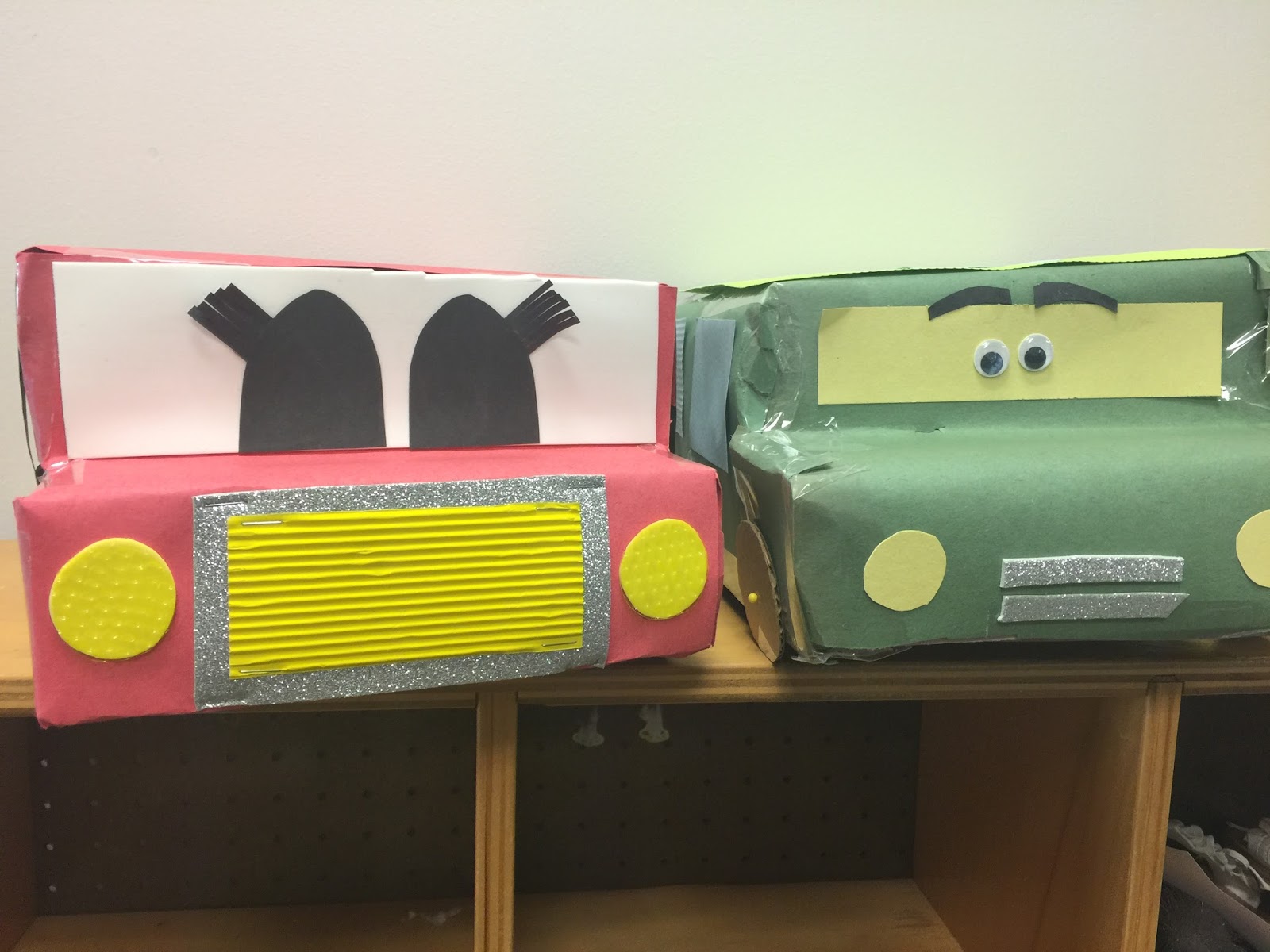
Look at the pictures and notice the use of lines, shapes and textures. These projects were simple enough that students could work with minimal support with making them but packed a big instructional punch. 

Now check out how another similar lesson teaches about shapes. This lesson used cars. The home lesson focused on squares and rectangles. The car lesson used the same concepts but also included circles. 


Here's my famous question: can you see how many areas of the Expanded Core are covered in these lessons? All of the areas of the ECC are covered in these lessons! Yep, these lessons involve all the areas from compensatory (concept development, organization, tactual readiness) to self-determination (self-awareness, making choices, self-instruction). These are great activities for the early childhood age students. 
You can purchase the APH Carousel of Textures from APH. Most of APH products can be purchased using quota funds. You can also check out activity ideas by using the TSBVI Elementary Concepts Curriculum. 

Wednesday, December 16, 2015

Holiday Banner

Merry Everything to Everyone--Christmas, Hannukah, Kwanzaa or Happy Holidays! Whatever you celebrate, let's have some holiday fun. I am a Christmas girl myself and so are the students that participated in our after school program.
We made these awesome Christmas banners for home decorations. It's an easy peasy project (especially for all the "not-so-crafty" people). I used the APH Carousel of Textures papers as well as few glittery papers I snagged for super cheap at Walmart and some construction paper.

I Googled a Christmas light clipart and used that as my template. I cutout a ton of lights using my template and all my different textured papers. The textured papers included glitter/sparkles (textures and visually appealing), velvet, bumpy, corrugated cardboard and rough. 


I printed out "Merry Christmas" on card stock. I made sure to use a font and size that were easy for my visual students to read. My Braille students made a Braille label  and put it over the print. 
Then, we used our favorite art friend, the stapler and whipped up these cute banners!
We chose red card stock as our banner base but you can let your Christmas creativity take you to new places and use other textures/fabric/paper. I went with red card stock for the durability, the easiness of it and the contrast with the lights. 


Did you read my last post on why the stapler is your art project's best friend? If not, go back to last week and read about it in the post "Textured Turkeys".


I've blogged a lot of about holiday projects over the years. Go back through my archives and check them out!
Remember, this is also STOCK UP time for your CVI supplies!! All those colored lights, red shiny ornaments and paper---stock up baby!

Tuesday, December 8, 2015

Wiggly Eye Sticker Chart

I was walking past this bulletin board in our of schools today when I stumbled upon this fun reward chart. This is an orientation & mobility reward chart by Linda Bredeen (a fab instructor). Let me tell you why I snapped a quick pic to blog about. Have you ever tried to use sticker charts for elementary school age kids with a vision impairment? It's doable but not awesome because there isn't a ton of fun for our kids with traditional stickers. Other alternatives are usually scratch & sniff stickers but even that doesn't always give instant feedback.  But check out Linda's idea with the wiggly eyes idea! 
I ran into her later that day and chatted with her about it. She told me that the kids LOVE using the wiggly eyes and they get a kick out of putting them on their chart. Lots of good feedback for the kids.  It's an easy peasy way to make a vision modification to an everyday school item. Have fun!


Tuesday, June 1, 2010

Teaching functional tactual skills--a great article to read!

I have one of the best articles for teaching functional tactual skills. It's kind of a lengthy read but it is packed with super awesome information. It's one of my faves to hand out when I work with education teams especially occupational therapists. The article is Feelin' Groovy: Functional Tactual Skills. If you have an OT who needs a little "vision impairment education", I highly recommend this article. I also love this article because I think it has great insight for working with children who are MIVI/DB.
Question: do you know what "functional tactual skills" are? Although there are many ways of describing this, the most user friendly way to describe it are these are skills that are part of daily living skills. For example, cleaning a table, folding clothes, etc. are functional skills. Tactual means touch. Students with vision impairments can be and mostly are tactual learners even if they have some usable vision.
Here's the link. It's from the Texas School for the Blind & Visually Impaired See/Hear Newsletter (a gem of info can be found here!!)
http://www.tsbvi.edu/Outreach/seehear/summer98/groovy.htm
Try it at home: think of 3 things at home that your child interacts with. Then ask yourself, what do these items tell my child? How does your child take in their information? There will be lots of posts later on object symbols and tactual learning. This is jus to get your brains thinking...