Showing posts with label ECC Resource. Show all posts

Tuesday, March 3, 2020

Support Independence for Students with Vision Impairments with a Teacher Feedback Group

Graphic of the title, support independence for students with vision impairments with a teacher feedback group

Are you loving our mugshots? These are some of the awesome people on our team getting into our new teacher feedback group. Back story: we have some new teachers, veteran teachers and new staff that struggle with knowing when and how to step back to support our students with their independence. It's a common problem. It's often an unconscious problem. People don't realize how much they are impeding our students. My team has good intentions. They have hearts of gold and they work hard but we make the same mistake: impeding independence. 
I wanted to continue to give my team feedback but I didn't want it to feel punitive or create a negative environment. Giving citations is a popular strategy for students in general education. Sometimes they are called "speeding tickets". This inspired this idea!  

an image of the independence violation with the funny male police officer holding his hand out to stop
I wanted to do something that I could get teacher buy in with. I created the (above pictured) "independence violation". Teachers could observe each other and cite them when they are impeding independence of our students. We all know these offenses: carrying their books, helping them open containers, serving them food, getting them whatever and not making them get up---the list could go on and on. I needed us to get present about this hinderance. We aren't doing students ANY favors by doing so many things for them especially our students who are completely blind. They don't pick up on the incidental learning. They need all these little opportunities for independence.
Again, I wanted something that empowers teachers. Feedback for instruction helps with this. But it can go wrong if not handled the right way. People can be sensitive. Fortunately my staff and I have a collaborative environment and we support each other. But....I still wanted to have fun with this. Enter my funny officer and our mugshots! The team got where I was going with this and everyone jumped on board. 

a mugshot of a female teacher wearing sunglasses with a tough expression
Important: I didn't want to just do negative call outs or citations. I wanted teachers to develop to learn how to give meaningful feedback. I added a section to the citation ticket that says "rectify the offense". This allows us to shift from the violation to a solution. We created a bulletin board where we post our citations/solutions and once a month we get together and review them.
We have loved this idea and the positive outcomes are far reaching. Teachers are now going to be more aware of their interactions with students. Teachers will find new solutions for how to step back. Want a copy of my citation? Send me an email and I'm happy to share. Try this out with everyone--parents, teachers and paraprofessionals. We included everyone (even my secretary) on this! Anyone who has interactions with our students was included. We are hoping our feedback group will help us move from villains to heroes! 

Friday, December 6, 2019

Teach the Expanded Core Using Nutcracker Dolls

 I'm baaaaaaccckkk!! I technically never left. I've just been more on 9MoreThanCore on Instagram. But I've missed my regular blog posts because I have so much to share and talk about. Back to regular posts so keep checking back. I've got a lot of fun stuff to share over the next few months.

A group of a variety different types of Nutcracker dolls sit on a table.
Now onto our topic: Nutcracker dolls. Every year I see Nutcracker dolls and I admire them. This year I was admiring and thinking. How fun would it be to use them for an Expanded Core lesson!? I realized that I could have a fun activity that infuses Expanded Core skills and specifically focuses on career education. Yes!

 As many of you know, these dolls aren't always cheap. They are about $20 each and I had a lot to buy so yikes! No fear here. I bought these at Michael's while they were half off. Then I used my 25% off coupon. Winner, winner chicken dinner! 
There's many different options for teaching.
Here's some ideas:
You can simplify it for younger students and just focus on the key characteristics.
Match the Nutrcracker dolls to pictures of real people.
Give characteristics of a career and allow students to choose the right answer by selecting the correct doll. 
Find real life objects that coordinate with the Nutcracker. 

Remember, use your tools (EVALS and ILSA) to help with identifying skills to infuse that are appropriate for your students. 
A teacher Nutcracker doll with the game sign "What is a school teacher?"
My Nutcracker activity is fun for campus students or around the house at home. I made a game of it. I start the first week of December. Each week I "hide" (in plain sight!) the dolls around my campus with Braille/large print labels so students can learn about a new career. There's a main Nutcracker with a basket. Students find them and write the name & career in whatever mode (Braille, LP or audio) and sign their name. Students put their answers in a basket and I pick winners each week. 

a large traditional Nutcracker doll with a basket and a game sign on how to play the game behind it.
Check out my first four that I "hid" on campus. Note: by hid, I mean they are totally available to be found pretty easy. The objective isn't to have my students randomly feeling everywhere hoping to find one. Each doll has a large print and Braille version (I used my embosser). 


A police officer Nutcracker doll with a Braille and print sign.

A chef  Nutcracker with a game sign in Braille and print.

A doctor Nutcracker doll  with a game sign in Braille and print.

Here is a close up of some of the dolls that I bought. I also bought dolls to teach about recreation & leisure activities.
An army and firefighter Nutcracker dolls

A professor and pizza chef Nutrcracker dolls
 This part is important: pre-teaching is a must! Below is a picture of my high school students exploring the Nutcrackers. Students are invited to check out the features as well as read the information cards. The objective of this game is to explore careers and recreation opportunities.
A female teen and male teens tactually explore two Nutcracker dolls.

Below is a close up of some of the game cards (they are full size 8.5 x 11). 

The game card for Chef Bakewell, the chef Nutcracker doll.

The game card for Doctor Gurnee, the doctor Nutcracker doll.
Okay, I have an idea if you don't have 10-15 Nutcracker dolls. Plan a community based instruction trip to a place like Michaels and have fun there! 
There's so much that you can do. Use your imagination!
Want a copy of my game cards? Send me an email: robbin.keating@gmail.com

Friday, March 29, 2019

Flipgrid + ECC =Success!


Image graphic that says Teach the ECC using Flipgrid

Have you heard of Flipgrid? Before I can tell you why it's so awesome, let me explain what it is.
From the website: Flipgrid is the leading video discussion platform for millions of PreK to PhD educators, students, and families in 180+ countries. Teachers set up "grids" which are topics. Teachers post questions or topics and students comment on them individually with their own video. General education loves using Flipgrid. I'm always thankful for our education technology specialist who keeps me in the loop of these things. We tested it with our AT specialist and realized that Flipgrid is very accessible (especially on Apple products with VoiceOver). Now that I understood what Flipgrid was, I knew I could use it teach the Expanded Core! The first thing I do is head to my ECC assessment tools and start making a list of EVALS skills. This helps me infuse skills into lesson plans. I always write lesson plans so I can focus on what my objective, procedure, ECC skills and instruction cues will be.

How can you use Flipgrid to teach the Expanded Core? 
This is an awesome idea for itinerant teachers. It allows me to do a lot of teaching remotely. I can post topics/questions/assignments and then students can respond to them. I use it in a variety of ways. Flipgrid is very helpful because it allows me to teach students who live close and students far. I currently have students that live 2 to 4 hours away from me. Important: you can't teach everything from the ECC on Flipgrid. But you can teach a lot of things! In fact, simply using Flipgrid is an ECC lesson because it alone has ECC skills. I love when I hear my students using VO when starting their videos. 

 I've included some screenshots. Below you will see my homepage with 3 of my most current "grids" (or topics). I use them in a variety of my classes. Currently I have 3 live grids: Study Abroad Canada, Accessible Arts Academy and Expanded Core.

Screen shot of Flipgrid screen with 3 grids on it.

Screenshot of the topic details page in Flipgrid

I post a variety of topics each class. This allows you to encourage students to "field trips". I assign students to do certain tasks and then video their responses. Don't just limit it to you (as the teacher) posting assignments. For my Study Abroad Class, I have a few students who are leading the discussions and posting topics. As the teacher, you can grade, provide feedback, etc. to students. I even invite guest teachers to join me and help teach. 

Screenshot of videos list posted by students.
It's hard to coordinate your schedule and student's schedules but Flipgrid allows you to (almost) have an authentic conversation on your own time. I post my topic/assignment/lecture thought and then I give a deadline for my students to reply. I also love that Flipgrid connects students. They don't have to be in the same place to interact with each other. They can reply directly to other's videos. It's a great way for students to get to know others. I also have my mentors join me as guest teachers (or called "co-pilots" on Flipgrid). 


Another feature that I like is that this mainstream general education. My students are using the same educational technology that their peers in their own school are using. They learn to upload videos, links, etc. and develop their tech skills. You can also use Flipgrid for PLCs!

Screenshot of a video Flipgrid page with a teacher making a funny face.
I've used Flipgrid for discussions, assignments, quizzes and even field trips! Sometimes I take my students on a "field trip" somewhere and video where I am or I have them take me on a field trip to show me how they would access a location. There is a time limit for a maximum of 5 minutes per video. I like that because it allows me to give direct feedback on a particular skill. They may have multiple videos that go with that skill and they can upload as many as they want for the assignment. I can give direct feedback to each video. 
We have a lot of fun taking the "selfie" for each video. We always end our videos and take pictures with a funny face. It's a fun tradition that we have in our Flipgrid discussions. I love how effective I can be utilizing this tool. There are so many ideas floating around on how general education teachers are using Flipgrid. I check out YouTube and other EdTEch sites to get ideas because I want to align how I use it with general ed. It allows me to teach my students to use Flipgrid like their sighted peers. 
Here's a tutorial on using Flipgrid:
My last idea for using Flipgrid: use it with your parents! As teachers, we have a special responsibility to teach our parents about the Expanded Core. Use Flipgrid to connect to your parents. You can take videos of their children doing lessons with you or to share bits about the ECC. It's vey easy for parents to learn, too! I'd love to hear how you use it for your ECC lessons.  I'll keep posting my ideas, too!

Friday, March 22, 2019

ECC Assessments


Hello friends!
Did you think I quit writing here on The Bee? I didn't!! I've just been busy on my social media accounts, 9MoreThanCore and developing SO many new programs. It's been busy and I have felt awful that I have neglected The Bee. Have no fear, I am here!!

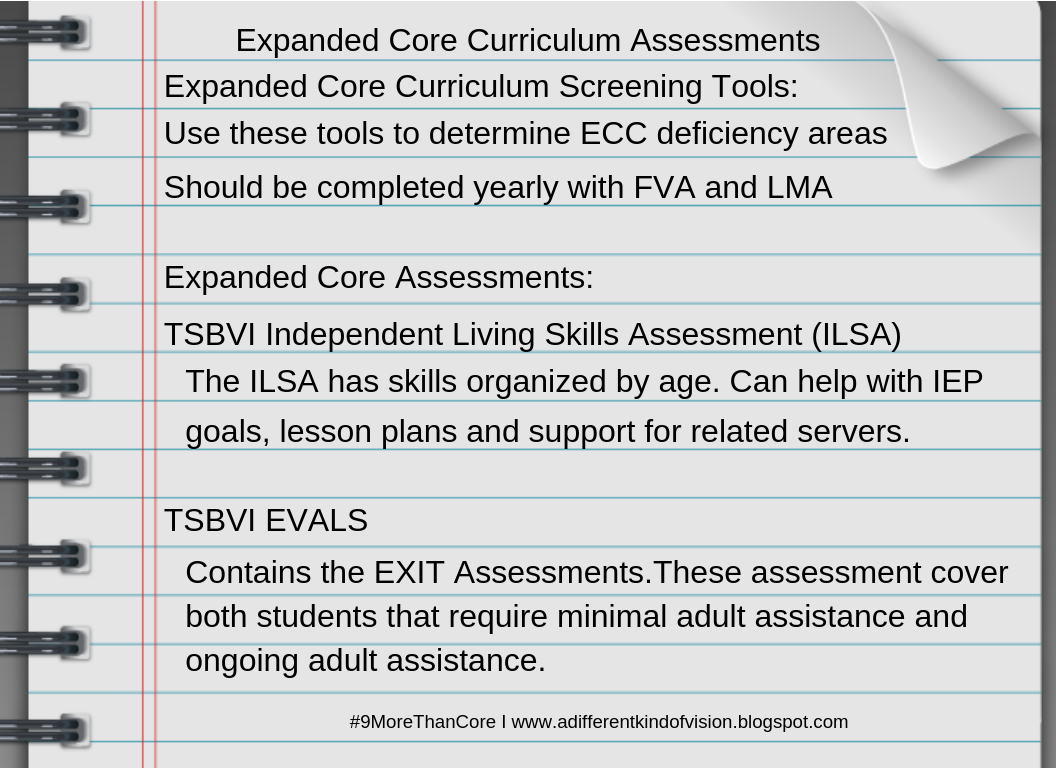
I find that many teachers are unsure about using ECC assessments. I whipped up a little image to help you see what assessments you should be using for the Expanded Core.

First, you need a screening tool. There are a handful of awesome ones that I love.
Here's a few links to some great screening tools:
The first one comes from the site EA Rubrics under the supervision of Dr. Karen Blankenship. Save this link because it has a ton of great resources for teachers of students with vision impairments: http://earubric-001-site1.mysitepanel.net/ecc-needs-assessment/
The other site is another treasure of items. It's Teaching the Visually Impaired by Carmen Willing. She has a really nice organized ECC Screening Tool: https://www.teachingvisuallyimpaired.com/ecc.html. I recommended becoming a member of her site. She has a lot of great resources.

Dr. Karen Blankenship advises all teachers of students with vision impairments to complete all three--FVA, LMA and ECC Screening Tool on a yearly basis. Many teachers are unaware of the resources that we have for ECC Assessments.  Our resources cover birth-21 and include students with additional disabilities. There truly is something for everyone! I encourage all my teachers, both itinerant and classroom to make sure they have access to EVALS. The EVALS kit includes the Independent Living Skills Assessment, Basic Skills Infused Skills Assessment, EXIT Assessment and  the EVALS ECC areas such as pre-Braille.  It can be purchased from TSBVI: https://www.tsbvi.edu/curriculum-a-publications/3/1030-evals-evaluating-visually-impaired-students.

Make sure you are completing the appropriate ECC assessment for your students and utilizing these awesome tools!
Happy ECC-ing!


Wednesday, November 21, 2018

Learn About Community Partners Using the Expanded Core

a graphic that reads the title of this blogpost
I just completed my latest ECC kit, Community Partners and I am so excited about it. One of my preschool teachers wanted a kit to help with teaching about community partners. Let me show what I came up with!
First, let me go right to our assessment tools and resources from the Expanded Core Curriculum. This way I can infuse skills in every aspect. I always go to my ECC tools first so I can have a clear picture of what skills, concepts, etc. I need to teach. I hit up the Independent Living Skills Assessment (ILSA) and Elementary Concepts from TSBVI (see earlier posts on using Elementary Concepts). There was a whole unit on community partners in Elementary Concepts so I copied the section for my teachers to use. Lots of good ideas for both core and Expanded Core learning (with art, music, writing, etc ideas). I also found some fun color and cut headbands from Totschooling.net (I signed up for free and they have all kinds of things). 
A picture of the Elementary Concepts community partners unit and the templates for the cut and color headbands
Next I hit up Pinterest and Teachers Pay Teachers to find some ideas and resources that general education is using. Remember, we always want to be in alignment with core and general education because it keeps our students included in their classrooms. Plus, TPT has GREAT finds that are pretty cheap. I love TPT!

Four of the movement community partners cards. For example: brush your teeth like a dentist
I found these awesome movement cards for $3.00 on TPT. They are available in large and small sizes (or in large print as I like to think of it...). Look at how great these cards are!! I had my intermediate grade students do all the Braille for me (bonus ECC instruction as we discussed as they brailled...). *You can't see the Braille labels very well but they are on there!*
I also went and found the props that go with each card. For example, a newspaper, wrench, toothbrush and cut up hose. Now we have meaningful tactual items for the movement. 
Screen shot of the Teachers Pay Teachers store where you can buy the movement cards
I happen to have some preschool items that I purchased for my early thoughts with dramatic play with community partners. You can easily hit up a Kid to Kid or other kids consignment shop for some items. I also purchased some from Lakeshore. Kids love to dress up for dramatic play (plus it's another ECC bonus because you can work on dressing skills!)

a picture of a doctor kit

an image of the mail carrier dress up outfit with Braille label
We added Braille labels to all the print labels on the dramatic play clothes. Add a little super glue (carefully!) so that the Braille labels stick long term. 

a picture of the back of the construction workers vest with Braille label on it

a photo of some of the community partners dress up outfits.

a photo of all the contents in the community partners kit
We packaged up the costumes into large ziploc bags and logged the contents. I like to do this to keep track of things. We are not done yet! We still have more items in our ECC kit. 

I also found this fun idea from Pinterest to build a photo town. Here's the link: http://www.toddlerapproved.com/2015/03/build-around-town-photo-wall.html.
There's lots of good ideas in this post! There are accessibility settings on phones (iPhones for sure) that allows students with vision impairments to take pics with feedback. Go around your town and take pictures of your town to build your photo town. See the post for more ideas. There are so many good ones that are totally doable for our students! Extend your ECC learning by visiting these places and taking your pictures there OR it can be ECC homework for students to do with their families. 
a photo of the blog post for the photo town
I decided to have some starter photos for our town so I Googled some free pics of things and made labels (with Braille on it--can't see in picture). It was easy peasy to make the board. Bonus ECC instruction: you can work in spatial skills directions because you can discuss top/botton, left/right and count squares and use systematic search patterns. 
a stack of photos from places around the community


a photo of the community partners kit
The last part of our kit has to do with signs in the community. We included a number of directional signs and this real working stoplight to talk about navigating around our community. This stoplight totally works! I found it at Hobby Lobby on sale for $40! It's got metal on it so it has an authentic feel. Plus it's great for students who have no vision who always hear people talking about a stop light but have never 'seen' it before. 
a photo of the toy street light from the kit
There is SO much learning that you can do with this ECC Community Partners kit! Other ideas include: asking members of the community to come to your classroom OR scheduling a visit to their location and build an experience book based on the community partners you learned about. Just make sure you hit up our ECC resources to see all the skills from play to compensatory skills that can be included. ILSA is a great tool for this! 
See you in the community!!


Friday, October 19, 2018

Teach the Expanded Core Using the Junior Achievement Program

I have to share one of my favorite resources for ECC instruction: Junior Achievement! Junior Achievement also known as JA is a serious jackpot when it comes to teaching the Expanded Core. I've been using it for years and have been able to use the curriculum to expand to all things ECC! I use a variety of JA programs for students as young as first grade through my high schoolers. Why JA? First, I did JA when I was kid and had some good memories of it. Now fast forward several years to my own kids doing JA. I was one of the parent volunteers for the big JA BizTown field trip. Holy cow, the moment I walked into JA BizTown I knew it was the Expanded Core everywhere! JA BizTown is a complete replica of a city with real life everything---cash registers at Chick Fil-A, city hall, post office, etc. Then I got to wondering what did JA teach. The question I should have asked was what doesn't JA teach!? 

Junior Achievement logo
I contacted Junior Achievement Utah because I wanted more information on the Junior Achievement program, the curriculums/programs and to let them know I saw potential for students with vision impairments to use them in a unique way (as part of our ECC instruction!). Side note: I always like to contact the company of a new product/curriculum that I use when I find ECC potential because I want them to be informed about our population of students. I also like to partner with them because the more they learn about our student's needs, the more everyone benefits. I've had such a good experience with this. So many companies have been open to collaborating with me! I have loved it!! Junior Achievement was top notch with working with me. I explained about the ECC, what I do and my vision for incorporating JA programs (as I knew it would look a little different with me...).  There were two other real stand out items that attracted me to Junior Achievement (aside from my fun time at JA BizTown): JA is popular in school districts so it wouldn't be something different for our students and JA programs are FREE! (note: It was free in Utah but I can't confirm this everywhere however I am super hopeful that it is!!).  JA programs are very popular in schools so it has a natural social conversation for our students to say that they are doing it, too. 

JA Personal Finance Program cover
Every JA program lists what elements of the Core curriculum it includes. I like it because I can easily see how I am targeting academic areas. Each program is divided into about 4-5 weeks. I follow the program as it is laid out because it is strategically put together.  I review the objectives and the extension learning for each unit and then I hit up all my ECC resources (you know, EVALS and ILSA) to make sure I am covering my ECC instruction.  I regularly take skills from EVALS and ILSA and infuse it right into my lesson plans. I also use my ECC Activity Worksheet (see my other post on it) to check my ECC instruction.
JA Ourselves Program Cover
I use JA programs for both my campus programs and my Outreach students (students attending their neighborhood schools).  I create quizzes for each unit and a final exam at the end of the program. (all on Google quizzes and Canvas). I LOVE JUNIOR ACHIEVEMENT!! Their lessons are thoughtful and laid out so well that it is not a headache for me to learn the material. I stick to the material from the lesson plan book and infuse A LOT of ECC before, during and after. 
Here are two examples of how I infuse ECC instruction with the JA programs: With It's My Business, I am doing an entrepreneurial program with my high school students. They are to do a group project on creating a Teen Club. I extended it that they had to do a formal presentation on PowerPoint/Google Slides. We paused the JA program and did some lessons on using AT for the presentation, what makes a good presentation, etc. (which still compliments the JA program). Another example is with my younger students with the JA Ourselves program, students earned "ECC Bucks" by completing simple tasks for various amounts around our school. Their "ECC Bucks" (real printed ECC money) was converted at the First National Bank of Robbin into real money. We headed to the grocery store and made a purchase (with instruction on needs and wants from the JA Ourselves program).
  JA More than Money
JA More than Money
I use JA as a class (in the ECC Lab  on campus) and as curriculum for short term programs (so much easier for my staff to follow). I do my best to stick to the grade levels that are established by the JA program. I modified the JA More than Money program for older students. It was originally written for younger students but the content was good and it set a foundation for the next program that we did. There are a fair amount of visual or not accessible materials but nothing that is impossible to work with. I retype all my JA lesson plans into Google Docs in large print because I always make a handout after each session for students to reference and study.  I do this because I keep my MacBook with me during my lessons. I take notes during the sessions because many times students will say things that help other students learn the concepts or expand the concept. I include that in the handout. 
My main accessibility resource is typing skills! I am grateful for awesome support staff that Braille items and set up things as needed. 

JA alumni are 30% more likely to have their bachelor's degree than the general population.
JA alumni are 30% more likely to have their bachelor's degree than the general population. 
Have I convinced you that Junior Achievement is a great resource for providing Expanded Core instruction? I have had a lot of success with it. They have programs on financial literacy, career education, leadership and a lot more.  Check out Junior Achievement in your area: https://www.juniorachievement.org/web/ja-usa/home

JA Career Success Program cover
If you use Junior Achievement, let me know! I'd love to collaborate with you. Junior Achievement Utah has been awesome to work with. Yay for another resource to provide Expanded Core instruction!!

Wednesday, October 3, 2018

ECC PTA: A PTA for the Expanded Core!

Graphic that says ECC PTA on a chalkboard with school books.
Graphic that says ECC PTA on a chalkboard with school books. 

A PTA for the ECC? What? Why? How? YES! A PTA for the ECC!! I wish I had a better title but I don't because everyone knows that a PTA is and I can't risk too many unknowns in this new startup PTA.

Why an ECC PTA? Because we need more when it comes to partnership with providing Expanded Core instruction! Parents, family and home life are such an integral part of teaching the Expanded Core and it is one of our weakest areas. We need to find ways to strengthen it. There is so much authentic learning that happens outside of the classroom or an itinerant's janitor's "office". The Expanded Core is our key to living a thriving, meaningful life. We must find ways to connect our 9 areas to parents, the living room, the mall, friends, sports, restaurants---everywhere! We as teachers need more help. We need our parents and families to become true partners in ECC knowledge. Too much is on the line for our students. Our educational model is kinda working. We need to do better. We have to think outside the box on how we reach everyone--teachers, students and parents about the Expanded Core. Viola! We have an ECC PTA! The sole purpose is to provide blindness specific skills and intensive Expanded Core information, resources, training and build a community for our families. The unemployment/underemployment rate for people with vision impairments is still between 70-80%. We can change that statistic! The Expanded Core is a major player to change that statistic! We have to do things differently because too many good, smart, talented students with vision impairments grow up to sit at home and do almost nothing because they don't have the developed skills to live a thriving adult life.

Parents, I invite to take a good look at your child and see if they have the Expanded Core embedded in their lives. This does not mean that your child is perfect. I am a mom. My kids are not perfect. I do my best to teach them, encourage them, hold them accountable, etc. I know that my kids will not listen to me all the time and need others "in the village" to teach them. I tag others in at times to be the teaching piece I cannot be because I am the natural enemy. But the difference between my kids and your kids is that my kids have incidental learning. They can see things and learn by watching even when it is not intentional. All students with vision impairments need the ECC because it fills in the missing pieces when incidental learning isn't happening. It is not a reflection of poor parenting.

We opened our ECC PTA up to all of our divisions--from babies to post high and then we thought bigger. We opened it up to outside of Utah. We have some live sessions where we meet together but we also are creating an format where a lot of it is a digital community. We are recording webinars, newsletters, interactive pieces for sure but something that would allow parents to be involved no matter where they are.

Our ECC PTA doesn't have major time commitments. There is no fundraising or selling popcorn. It is established for the purpose of building a community for our families. It doesn't matter if your child is typically developing or has additional disabilities. The Expanded Core still applies to you no matter what!

The first thing we covered is to learn what the Expanded Core is and why it is critical that parents/guardians understand it. If you are new to my blog, that is the first thing you need to do. Read more posts on the ECC, email me for my tip sheets or do a Google on the Expanded Core Curriculum for students with vision impairments.

The second thing is to have a resource toolbox. My blog is just one tool. Your TVI is another excellent tool. I also suggest to invest in the book ECC Essentials from AFB Press (sold by APH on APH website or Amazon. I'll link it!). We will have a book club posting on this in a few weeks. I also facilitate social media on the ECC. Follow 9MoreThanCore on Facebook and Instagram (same name, different content).
A picture of the cover of the book ECC Essentials
Amazon link: https://www.amazon.com/ECC-Essentials-Teaching-Curriculum-Impairments/dp/0891284982

Shop APH Buy at Shop APH

Last but never least, join the ECC PTA! Click here for the registration link. 


Thursday, June 28, 2018

Teach the ECC at a Cowboy Dude Ranch!

 Yeehaw!! Howdy partners, let's teach the Expanded Core Curriculum out on the range!  We spent four days at the Rocking R Dude Ranch and got country strong on our ECC skills. Many programs look to do a variety of programs for our students. Going to a dude ranch was a first (but definitely not a last) for me! First, let me tell you that this was not designed to be any kind of luxury country getaway for students. I wanted students to dig in their boots to cowboy life with the ECC. It was a hit! Each day we did real chores (emphasis on the word "real"), spent time developing true global concept development and we had some serious fun! Students had to brush and prepare their horses, lead them to the arena and then learn how to ride. They got up early to watch and be part of the early morning care with the horses (watching them with the wranglers was awesome!!).

Student brushes a horse in the early morning.
Student brushes a horse in the early morning. 
As usual, I did receive a slightly panicked phone call from the owner when he saw that I was bringing a large group of students with vision impairments (everyone is always a little concerned...) but after our discussion, we knew that this was a good idea! Once we got there, I definitely knew it was a good idea!! I spent time reviewing activities and working accessibility needs prior to us arriving. My awesome staff spent the first day on pre-teaching alongside of the ranch staff. 
Female student sits on her horse listening to instruction from a dude ranch staff.
Female student sits on her horse listening to instruction from a dude ranch staff. 
Always remember to request (or bring) multiples of items so everyone gets lots of hands on to help with concept development. We had a ton of lassos, access to all the saddles, brushes, etc. so that true concept development could happen. Students didn't just touch one part of the animal. They learned about the food, its shelter, its weight, leisure activities, etc. Each group traded trivia questions that they came up with. 

Female student has roped a practice bull with her lasso while another student gets up close to a lasso with a staff member.
Female student has roped a practice bull with her lasso while another student gets up close to a lasso with a staff member. 
My FAVORITE thing to do is to help students see how the ECC is EVERYWHERE in their lives! Repeatedly throughout the day I worked with every group about how and why their activities were ECC skills. We have definitely gone past the easy point of simply stating "this is independent living skills because I am eating," (that's just our starting point...). We really dig in to why the cafeteria is a place for ILS skills, what about what they are doing, we dig into every single aspect so that they can see how it is SOOOO much more than independent living skills because we are eating. In fact, we always discover how so many areas of the ECC can be tied to one activity. It always opens their eyes to seeing how the ECC is truly all day, everyday. 
Students are in a circle for lawn games playing a game.
Students are in a circle for lawn games playing a game. 
Female student walks her horse into the arena while an adult staff leads on the other side.
I loved being at the dude ranch because it allowed all of my students to connect to the world in ways many of them don't get to experience. They had to problem solve while riding their horses. They had to work their teamwork skills as they were tubing down the river. They saw how important it is to care for an animal in real time. Of course many students have had animal interactions before. But this  opportunity allowed them to go bigger and bolder. They had plenty of time as no one was rushed through anything. We even had a real rodeo where all the students (and a very slow riding teacher named Robbin) did barrel racing and pole bending. 
Female student is hands on with goats with an adult staff member
I always love doing programs in the community for a variety of reasons. One, it helps the community see ability instead of disability with our students. They learn so much about accessibility and ability of people with vision impairments. I always offer to do free trainings, leave tactile maps, etc. so I leave the facility more accessible for the next blind person.  Two, the more I do things in the community, the more my students learn about what's available in the community. Three, I hope that it creates the opportunity for my students to return to the location with their family and friends outside of a program/camp. 

a female student is on a barrel to simulate riding a bull while other students pull attached cords at the corners of the barrel for the simulation
I could go on and on about our daily activities and how fun (and so educational) they were. Our evening activities matched the day with ECC fun! We had campfires (who doesn't love a good fire and camp songs?!) as well as learning how to line dance with a live country band! I secretly love line dancing because it is such a fun way to teach so many orientation and mobility skills! 
A group of female and male teenagers stand together with their life jackets on before going tubing in the river.
A group of female and male teenagers stand together with their life jackets on before going tubing in the river. 
The magic of camp can continue as long as we work hard to connect skills from camp to the real world at home. This is the part that often is a negative for camps and programs for our students: it's not in the student's real world. How do they keep their skills going? Where are they going to get a horse again? Well, the horse I can't help with but the skills part I can. Even though we were at a dude ranch, I kept focusing on the take away lessons and skills. We do this every camp and program. How can you take home what you are learning at camp? How can I empower parents to help keep the magic going? We have to close the loop and help students learn to generalize their skills to other environments. First I focus on the immediate environment but then I start leading to master in many environments. It's an important part of all our programs!
Get your cowboy boots on, grab your hat and head to a dude ranch for down on the range ECC instruction!!